
Chapter One — Gnosis
The X-ray had been on my email inbox since that Tuesday afternoon when a chime brought my attention to the computer’s monitor. By Thursday afternoon, when I had taken care of the last of my patients’ house calls and gotten home, I had had the time to look at the image in that email three times without permitting myself to read it.
There is a difference between looking at and reading medical imaging. To look at a CAT scan, an MRI or an X-ray is to record what one sees, present and undeniable, but not yet rendered into medical terms that describe what is shown. To read medical imaging is to mentally translate the results into a sentence about a person’s life; most times, that sentence is a good one, or one that involves a course of treatment. Sometimes, though, the sentence rendered means that a life is coming to its end, and that was the case for Roger’s chest X-ray. Looking at it, it was clear; but I was not ready to translate what my eyes had caught into sentences that began with the words, terminal carcinoma. I only let myself read the imaging two days later, alone, with the door of my office closed and the house around me settled into the quiet of dusk.
The imaging was unequivocal. There was a large, well-defined mass in the right upper lobe, of a size and configuration that I had taught a generation of medical students to recognise; and, accompanying it, there was a lymphadenopathy in the mediastinum that one does not see in the lungs of those who have any meaningful time left. I looked at and read the image once more; then, I sat back in my chair, put my hands flat on the wood surface of my desk, and waited for whatever was going to come next.
I think it was the desk that held me there. Its solid wood structure was old before it came to me, picked out by Amy after the first of our yearly trips to Catalina, when she had decided, without consulting me, that the desk I had been working at was beginning to fail at its corners and would not do for another decade. She then had chosen this wooden colossus to be my workstation. The grain of its wood under my palms had absorbed, in the fifteen years since, a great many of the difficult things I had had to do at it: telephone calls to families about their fathers, the writing out of one prescription or another that I knew would not be enough, and the small rituals of composure by which a doctor remains one when the person would rather not.
I let the wood do its work.
The face in the darkened window across the room was the face of a fifty-seven-year-old woman. I knew this in the abstract, as I knew I had grey at my temples, and as I knew that my hands had begun, in the last year or so, to bear the slight, tendinous prominence that Roger’s hands had borne when I had first met them. What I had not allowed myself to know, until that Thursday, was that I was now eleven years past the age Roger had been on the night he had caught me by the wrist in a Tenderloin alley. He was forty-six then; I was eighteen. The arithmetic was not difficult, and it had been available to me at any point in the preceding decades; what made it different that Thursday was that in that same instant I was also reading his chest X-ray, and I understood with the small clean shock of all true comprehensions that now he was not just my Master and my friend, but also a man at the end of his life, and that I, whose entire adulthood he had assembled out of my anger and his patience, felt an obligation to be by his side, now and until the end.
I sat with that for some time. I was aware, peripherally, of the house’s small mechanical sounds: the refrigerator in the kitchen down the corridor, the faint hum of the lights, and the irregular tick of the radiator that had needed adjustment since the autumn before. I was aware of my own breath, which I had to school, more than once, away from the rapid shallowness it kept proposing. I was aware of the scan on my monitor, which had become a presence in the room as unavoidable as a third person.
After perhaps a quarter of an hour, I picked up the telephone.
Roger had kept the rotary apparatus into his eighties; everyone who knew him knew this, and everyone who knew him made the small allowances that came with it, dialling slowly, listening to the singular old click of a phone that no longer existed in the world. I had paid, some years before, for a second line into his apartment with a modern receiver, on the argument that he needed one for emergencies; he had accepted the second line and, characteristically, never used it. To call Roger was to call the rotary phone. He picked up on the third.
“Fukuyama.”
“Hello, Master Roger.”
There was the slightest pause: the kind of pause that a man with breath to spare does not make, and that a man whose breath is now rationed makes whether he intends to or not. I heard, beneath the word that did not yet come, the audible labour of his lungs, the soft wet edge that I had been pretending was not present in our last several telephone conversations and that I was now, having read the X-ray, no longer permitted to ignore. I chose to dispense with light chatter.
“You have the X-ray, I take it.”
“… I do. The oncologist’s report… came on Tuesday. I… I don’t have much life left.”
I closed my eyes. He had had it as long as I. He had decided, in his way, what he was going to do with it, and then he had waited, with the same level patience he had once used to wait for me to recite a greeting to his satisfaction, for me to come to him in my own time. I should not have been surprised. There had never been anything Roger had not already known about a situation in which I was a participant. It was something that infuriated me about him, and part of what had made me trust him with my life.
“You know what I am going to do now,” I said.
“… I know. I also know… there’s no force on Earth… that will stop you.”
“All right, then it’s settled.”
“… You are coming down this weekend?”
“I am going there tomorrow, and I’m staying with you until the end.”
“… You have a practice.”
“I have a practice that will keep. I will come tomorrow.”
He did not argue with me. He had, perhaps during the past year, passed the threshold at which he had begun to permit me to make decisions on his behalf without his interrogating my reasoning. It is a shift one notices in the parents and teachers one is going to lose. I had noticed it in my mother, and I was noticing it now in him. I had hoped, as one does in the face of every such shift, that I had been wrong. The X-ray told me otherwise.
“… Bring Amy too. I… I would like to see her.”
“She’s always glad to see you, Master.”
The word came out before I could prevent it. I had not said it to him, aloud, in over thirty years. I had often thought of him as Master, in the privacy of my own head, when I had been doing some difficult work that his training had made possible, but I had not addressed him like that since the Tuesday afternoon he had unbuckled my collar and said, You are free now, Ms. Marquez. I heard the word leave my mouth, and the small breath he took on the other end of the line. I did not retract what I said, and he did not correct me. He only said, with the same level neutrality he had ever used:
“… Drive carefully.”
“You know me better than that, Rog. Careful is my middle name.”
“… Tomorrow, then?”
“Yes. Tomorrow.”
We did not say anything else, and we did not put the receivers down. I could hear his breathing, and he mine. I was aware, in the stillness of my home office, of the diffused light reflecting on the window, the X-ray on my monitor, the wood under my left hand, and the smartphone in my right; I imagined he was aware of his own environment in a similar way: the rotary telephone on its small table, the bookshelves I knew by heart, full of books I had read more than once, and the kettle on the stove.
I do not know how long we sat with the line open between us. Roger hung up first. It was a small kindness, because I would not have known how.
I sat in the chair for several more minutes. The valley light had thickened by then into a misty golden hue, and the X-ray on my monitor was now indistinct in the falling dusk, no longer requiring of me any further reading. The world wavered, so I took off my eyeglasses and pinched my nose.
My fingertips were moist.
I could not break down, though. I had a practice to organise so that I could be absent from it for an indeterminate time. I had to telephone my answering service, my colleagues, and the patients with appointments in the days to come; I had to talk to Amy, who, just by looking at me, would know everything before I said a word. I would do all of it, carefully and well, in the manner Roger had taught me to do everything I did.
For the moment, however, I stayed where I was, in my home office, with tears threatening my eyesight, at dusk of a late spring Thursday evening, and let the room hold me for a few more minutes before I began preparing, by stages, to be at the deathbed of a man I had called Master, who had done so much for me, whom I considered much more than just a mentor, and whom I now had called Master again after thirty-odd years without thinking twice about it.
Chapter Two — Limen
We drove down with the Volvo estate at first light the next day. Amy had quietly and quickly packed for both of us the night before while I worked from the kitchen island through the small arrangements that my absence required.
As I checked everything and called our housekeeper, Amy’s hand had brushed mine when she came past with green tea for both, and that had been the only conversation we needed about the matter. We headed out in the morning mist, the tote settled in the back seat, the route one I knew by heart from decades of doing it both ways.
Amy turned her face to the window and watched the valley pass into the bay’s distant grey shore. The conversation we had had at the door of our house, the one in which I had said “thank you for coming with me” and she had said “of course, Mistress; besides I’m your spouse,” had taken less than ten seconds and had said everything we needed to say about her position in what was about to happen. Beyond it, neither of us required language. The road did the work that words would have failed at.
The Mission district had not changed. Other neighbourhoods in San Francisco went through reinventions and even second reinventions, but the block of warehouses where Roger had bought his floor in the late seventies held its shape the way Roger himself held his, by refusing to participate in fashion. The sight of those same brick fronts, painted-over signage, and iron fire escapes made it feel as if I had left that block yesterday; and, halfway down the block, there it was: the heavy door at the foot of the stairwell that I had first walked up at eighteen, feeling Roger’s sight on my back and a knot of anger in my throat.
I parked the car. Amy did not move to get out. She was waiting, the way a careful body waits when it does not yet know the protocols of where it has arrived; her hand was on the door handle without yet pulling it. I rested my own hand on hers.
“Stay close,” I said.
“I will; but Mistress? Please, don’t worry. It’s not far, and I don’t think I will be violently abducted and assaulted in less than a hundred feet.”
I chuckled and said, “Why, oh, why did I ever marry such a brat?”
Amy said, deadpan, “The power of blond compelled you.”
I shook my head and sighed, perhaps exaggerating frustration a bit; but the truth is, Amy had made me smile. I looked at her with a wry grin, and said, deadpan, “And my name is Brunette Legion.” Amy laughed, and I put my arm around her, holding her close to my side for a moment. I kissed her cheek, and said, “Thank you, my love, for keeping me smiling.” Amy leaned into me and said, “Always, my love.”
I drew back and gathered myself, looking at the heavy door that led to Roger’s apartment.
“His protocols are not ours, love. I will tell you, in real time, what to do.”
“Yes, Mom,” Amy said. “Seriously though, I got this, love.”
I shook my head and softly laughed. “You,” I said, “are incorrigible. Thank you, though. It means a lot to me that you’re here with me.” Showing that slightly provocative humour of hers was all Amy, and her timing was impeccable, making the moment smaller right when it needed to be. I noted it and was grateful.
We climbed the stairs. They smelled the same as I remembered. The walls were the same painted concrete as ever, the rusty iron railing as wobbly as it had always been, and my body, with the unconscious fluency of muscle memory, remembered how to ascend those stairs without looking down.
At the landing, I stopped before ringing the bell, because I needed a moment to be the doctor again. The doorknob was worn smooth by forty years of other hands besides my own, and the metal was cool.
I rang. An electrical buzz opened the door for me.
The smell was that of Roger’s flat: Books, dust, the residual mineral hint of long-cooled tea, and, beneath the olfactory texture, faint enough that one had to know to listen for it, the soft hum of a concentrator, a piece of machinery whose function was to support compromised lungs. I had time, in the second between the door’s opening and my entering, to feel the floor of my chest drop very slightly, and, before I stepped through, to permit myself the luxury of that drop.
The bookshelves were exactly as I had left them. I went to them before anything; I had to. I walked their length at fingertip pace, from West Point at my left through the Mekong Delta in the middle to the post-war shelf at my right, where Aristotle and Marcus Aurelius lived, and my hand grazed the spines in the order I had once read them. Both the annotated and the clean copy of The Anabasis were where they had always been, one next to the other; my palm rested on the cracked cloth of the spine for a moment longer than the others. My own hand, I noticed, was now older than Roger’s had been when he had first put that book into it.
The kitchen was as simple as ever. The kettle was the same black, cast-iron one I remembered. The two cups on the shelf were still the ones I had cleaned, one of them chipped at the lip from my accidentally clipping it against the faucet. The cement floor between the rugs bore the same scars I had memorised in my adolescence, and the rugs themselves, made of knotted wool and from half a dozen provenances, strewn in the strategic disorder Roger had perfected, lay where they had always lain.
The apartment was, obviously, competently maintained. Whoever had been coming here had moved through the room without disturbing it, which was itself telling about who Roger had let in. Amy stood at the threshold without entering, the small canvas tote at her feet. I had not yet invited her in. The manner in which she stood, waiting for me to give her permission to enter, showed her training held, which in turn reflected on my own; and seeing her there, motionless, attentive, reading me as I revisited the place where I had been reborn, I felt the grief of recognising that I was losing the man at the source of both of our rebirths for the first time since seeing the X-ray. “Come in, mine,” I said; Amy picked up the tote and crossed the threshold. I did not yet take her to see Roger. Instead, I walked her through the kitchen and the living room first, because the former was where she would do the work that needed doing in the days to come; and the latter would be where our lives would intersect outside of Roger’s room.
I showed her where the kettle was stored, the cupboard with the loose-leaf tea Roger preferred, and where the small enamel saucepan he used for soup was. She nodded each time and committed everything to memory, the way she had at Marge’s diner sixteen years ago, and with the same unhurried attention. Then, when I felt we were both ready, I went with her to Roger’s room. Its door was ajar. I pushed it open, went in, and did not look back to see whether she followed; I trusted that she would stay at the threshold until I called her in.
The room was small, dim, and smelled of everything sickrooms smell of. At its centre, propped against three pillows, was the man who had grabbed my wrist in a Tenderloin alley thirty-nine years ago. He seemed thinner than I remembered, and the cannula at his nose ran to a small concentrator on the bedside table that someone else had set up. His hair was white now, but his eyes had lost none of their intensity.
I did not, for that first moment, behave like a doctor at all. I crossed the floor and went to my knees beside the bed; then, I took his hand in mine, and what came out of my mouth was, simply, “I’m here, Master.”
It was the second time in over thirty years that I had uttered that word to him, this time in his physical presence. His eyes opened a degree wider and found mine; then, he made a small attempt to tighten his fingers around mine. That was what his strength now permitted him as a greeting. He said, quietly and on the half-breath that was all his lungs had to give: “… Hello, Anne.” We did not need more. I knelt by the bed for several minutes, with my hand in his and my forehead almost touching the sheet, and I let myself be exactly the small, vulnerable thing I was at that moment, before becoming doctor and caretaker for the next several weeks.
He let me. It was one of the most poignant lessons he had taught me: that there were moments when protocol must yield to humanity, and the failure to recognise those moments was a failure of leadership from which there was no recovery.
When I rose to call Amy in, my eyes were moist and burning, and I did not deny myself that feeling. She quietly came through the door and did what I had not even told her to: she went to the foot of the bed, knelt, and lowered her head. The collar at her throat caught what light there was. Roger’s eyes moved to her; his mouth made the small effort of a smile and said, in the half-voice that was now his: “… Welcome, Amy.”
Amy’s eyes shone with unshed tears. Without a word, she rose and stood at the foot of the bed, with her hands folded at her waist in the position I had taught her years ago for waiting in a room that was not ours. Roger looked at me again. He said, “… We need to be clear… about something, Anne.”
“Yes?”
“… I don’t want… whatever time I have left… to be a living wake. I’m only dying… and I’ve lived long enough… and well enough… to have no regrets.”
“Understood.”
“… You will not let Amy… do anything… you did not approve. This was… and is… your house.”
“Understood, Master.”
“Good.” His eyes moved between us.
“Amy?” She lifted her chin a fraction. “… You will obey Anne… not me. I am… not your Master. I am the man… your Mistress once called Master… and here… you will hear her… say it often. That word… in this room… belongs to her.”
Amy’s voice was low and steady. “Yes, Sir.”
He nodded. The conversation had cost him air. I was watching the rise and fall of his ribs, and I knew, the way a doctor knows, that we had reached the limit of what he could do without paying. I leaned, adjusted the cannula by a millimetre, more for my own sake than his, stroked his snowy white hair, and said, “Please rest, Roger. We are here. We will be here… u-until the end.” He nodded again and closed his eyes. Within a minute, by the change in the rhythm of his breath, he was asleep.
Amy and I stood in the doorway for a moment, watching him. My eyes were misty again, and I was feeling like I felt when I knew Julia would not be with me for much longer. Amy brushed her thumb against my cheek, and it came moist.
“Oh, Anne…” she said softly.
I took her hand, and we went back to the front of the flat together. I suddenly felt exhausted, and my eyes would not stop tearing up. The kitchen received us the way it had always received me. It offered the kettle, asked for nothing, and permitted both of us to put down the things we could not yet carry.
I filled the kettle from the tap. Amy reached for the two cups on the shelf without my asking, saving the chipped one for me. Doing these menial tasks with Amy calmed me, and, though I still felt drained, I no longer felt like I was on the verge of emotional collapse. We did not say anything while the water heated. When the kettle whistled, I took it off the burner, added the tea leaves to the cups, poured, and let them steep.
Green tea, shared with Amy, in this room, helped ground me into this new, unavoidable chapter. The light, golden brew, which had accompanied me in mending my many breakages under the tutelage of the dying man I was now caring for, accompanied me once more, grounding me for my farewell.
We washed them when we were finished. Amy passed one to me, and I dried it with the towel that hung where it always had; as she handed me the second cup with both hands; her fingers brushed mine, and I knew she was telling me she would be there for me when I was ready. I was grateful for that, too. Then, I put the second cup back on the shelf where it had always been.
Outside, the afternoon was beginning to yield to evening over the Mission rooftops. Somewhere down the block a car door slammed and a child laughed. In the bedroom at the back of the flat, the man who had made me was sleeping. In the kitchen at its front, Amy and I stood beside each other, and neither of us could yet speak about what was happening.
Chapter Three — The Patient
It was perhaps an hour before I went back into the bedroom. The kettle stood empty on the stove and the cups stood washed and shelved by then; the front room had passed through the quiet reorganisations of arrival, and Amy, at the kitchen island, was already turning the day’s provisions into nourishment for the three of us. She did not look up when I passed her. I went alone, because what I had to do next was private work and, personally, I prefer to visit a patient on my own, unlike other colleagues of mine who enjoy having a fawning entourage of residents and interns around them. Amy had understood, the way she understood most things, that the next step belonged to me alone.
I had brought my medical bag in from the car. It was twenty-eight years old, a graduation present from Roger when I had finished my residency, with an inscription that I had stopped showing to colleagues some years before, because the explanations it required exceeded what the question deserved. I had done a great many examinations with that bag, but never would I have thought, until that Friday afternoon, that I would bring it with me to examine the man whose inscription was etched on its inside flap.
I let myself in. Roger was awake; his eyes had been on the ceiling when I had come in, and moved to follow me as I entered and set my bag on the nightstand in the same way they had moved, decades earlier, to follow my hand on a cup of tea or as it scanned a copy of Marcus Aurelius, with the patient attention of a man who had taught me that no domestic motion in his vicinity was beneath observation. I said, “I am going to perform a physical examination now, Roger.”
“… Please do, Anne.”
“It will not be brief.”
“… I have… nothing else this afternoon.”
I removed the stethoscope first and set it across the back of my neck, the way I had been doing it since my third week of residency. Then I sat on the edge of the bed without asking permission, and I said, “Please open your shirt.”
He opened his shirt. The fingers had the slight, tendinous prominence I had remembered them by; the shirt was the same plain cotton he had ever worn at home, and the buttons gave to him in the way the buttons had always given, with the economy of motion of a man who does not waste any motion. The skin of his chest was thinner than I remembered it. It was the skin of an eighty-five-year-old man, with the bruising the cannula’s tape had begun to make at the side of his nose and the small areas of nascent decubitus that I had been hoping not to find under the shoulder blade and behind the heel.
For the first time in my life, I put my hands on Roger. I listened to his heart first, because the heart is shorter work than the lungs, and I wanted to give him the easier interval before the harder one. The rate was elevated, but the rhythm was regular and there was no audible murmur. Had he not gotten lung cancer, Roger would have lived well into the century mark. I moved the stethoscope’s bell over the carotid and heard the bruit I had expected to hear, neither louder nor softer than the years would have predicted. Then, I palpated the supraclavicular fossa on his right shoulder and there I found the firm, painless nodes whose presence a radiologist’s report can describe only with the words suspicious for metastatic disease.
Then, I auscultated the lungs. They were what they were. The breathing sounds at the right upper lobe were diminished to the point of absence, with the dull percussion that confirmed what the film had already told me; over the rest of the right lung field the air entry was poor, and the wet, soft crackle I had heard at the end of the telephone line on Thursday was confirmed at close range as the rales I had been afraid I would hear. The left was, by comparison, almost normal, though I would not call the breathing of any eighty-five-year-old normal. I counted his respiratory rate against the second hand of the wristwatch I had inherited from my mother, and I made it twenty-four. I counted a second time, more slowly, and the count came out the same. The pulse oximeter at his finger read eighty-nine per cent, which was about what the home concentrator delivered, but as things stood that would not stay that way for much longer.
I performed an abdomen palpation, feeling the lymph nodes and internal organs, then tested his reflexes and checked his limbs, taking stock inventory of Roger’s body in a way that allows a doctor to confirm what imaging and labs have already said in terms of skin, pulse and presence. He cooperated with all of it, not speaking unless I asked him a question, and giving me the answers I required with the discipline of saying only what was useful. I briefly took the cannula off his lip to look at the nasolabial skin underneath; then, I lifted his hand and looked at the nail beds; I asked him to cough, and he did, twice, which cost him three breaths he could not really spare anymore.
When I finished, I sat for a moment with my hand resting on his forearm. For a while, I did not say anything. He did not say anything either. There was nothing in what I had found that he had not already known, and there was nothing in my silence that he was misinterpreting. I had, at most, confirmed the document he had been carrying, in his own body, since some date several months before his oncologist’s report.
“The bad news is you have cancer,” I said. “The good news is that, had you not gotten cancer, you would live well into the hundreds.”
My eyes were misty again. I had to close them for a moment. Roger snorted. It was all he could do to laugh without breaking out in a fit of coughing he no longer could afford.
“… That’s… encouraging,” he said. I took a deep breath and, doing my best to stay composed, I said, “Tell me what you are taking, Roger.”
He told me. His regimen consisted of long-acting morphine at a modest dose, plus a fast-acting analgesic for breakthrough pain; an antiemetic he had been using sparingly; and benzodiazepine for the nights when the air hunger crowded out sleep. He named the dosages, the schedule, and the doctor who had prescribed them to him.
I knew her by name. She was a palliative care physician at one of the city hospitals, about my own vintage in practice, and with a reputation for competent, solid work. I noted, as he spoke, the cadence with which he said her name, and did not comment on it. It would have been beneath both of us to do so.
“Someone has been here to keep house,” I said
“… Yes. Mei… Mei Tanaka… She comes on Tuesdays… and Fridays.”
“How long has she been coming here?”
“… Six weeks. She is good. You will like her.”
“Where is she from?”
He paused, briefly, and I heard the audible effort in the pause. “… Japan. She came to me… the way you did… after losing her mother… to the pandemic. She… is no longer mine, and she… is also a nurse practitioner.”
“I see. So, apart from being a Master, you are also a one-man pre-medical program, Rog.”
“… Anne… You will not… be territorial.”
“Being territorial is not my primary worry right now.”
He did not need to call me out about my being proprietary, but he did so nonetheless, because he was Roger, and because he had spent years correcting that tendency in me, one I had spent most of my life managing.
“Good.”
I rose, re-buckled the bag, and said, “I am going to call your prescribing doctor this evening. I will not change anything yet. I want to talk with her first.”
“… Roger that. Do… what you need.”
“I want you to rest now. I will bring tea later.”
“…Yes, Doctor.”
He did not say it in the register in which he had said Hello, Anne an hour before; he said it in the small, dry register of a man making the formal acknowledgment he had now formally committed to, in a room in which the formal acknowledgments still mattered. I took it as he meant it. I did not bow, because I was no longer a person who bowed in this room, but I lowered my chin a degree, and I went back to the front of the flat to begin the work of being his doctor in the manner that had now been, by the contracts of two lifetimes, properly authorised.
Amy had already done several things. She had wiped down the kitchen surfaces, which I had not asked her to do, and which had needed it. She had set my doctor’s notebook on the small table beside the rotary telephone, with a pen across it. The canvas tote was still where she had set it down by the door on entering, because Amy did not unpack until she had been told where her things would go, and that conversation had not yet been had. The kettle was full again. There was a pot of soup simmering on the back burner, with the lid set ajar and the spoon resting on a folded towel. The flat smelled, faintly and for the first time in a long while, of garlic and onion.
I sat at the kitchen island and put my forehead in my hands for the brief interval that the work would permit me. Amy did not approach. She continued her work at the stove, with her back to me, and let me have the interval. When I lifted my head, she did not turn; she only said, without inflection, “Tell me when you can.”
“In a moment.”
“Yes, Mistress.”
I took the moment. The light through the high industrial windows had gone the colour of old brass, and the ironwork on the fire escape across the street made its long thin shadow on the painted brick. Somewhere on the street below a man was calling to his dog by a name I could not quite hear. I watched all of it and did not think anything, for as long as I could permit myself not to think anything, and then I lifted my head and began to speak.
I told her what I had found. I told her in the clean clinical terms that a doctor uses with another doctor, because, though Amy was not a doctor, she had spent sixteen years in a household with one and had absorbed the vocabulary by attrition, allowing me to use it without softening. I told her what I expected the next several weeks to look like, and what I expected the last several days to look like. I also told her about Mei. Amy listened without interrupting. She stirred the soup with one hand, on the slow even cadence she used when she was committing something to memory and, when I had finished, she set down the spoon, turned and looked at me.
“What do you need, Mistress?”
“I need to call his prescribing physician. I need to write some notes. I need, after that, to eat something, and to be near you for a while before going back to him this evening.”
“All of that is possible.”
“And you?”
She considered the question. She did not, the way she sometimes did, set it aside in favour of mine. After a moment, she said, “I would like, when you are ready, to be told what to call him. I have been calling him Sir, in my head, since the bedroom. It is not the right word, and I do not yet know what is.”
I had not thought of it. I should have, and she was right that it had not been settled, and that it mattered. I considered for a moment. He had been my Master and teacher, and now he was my patient and the man whose moral authority over me had been formally distinguished from my medical authority over him. That man, lying in that bedroom, had been my anchor for five years. And that had saved me. Friends don’t do that, and strangers don’t either, not for free. The cost of Roger’s tutelage had never been clear to me… until now. Roger, for all intents and purposes, was family to me.
“When you address him, you will call him Roger. If he asks you something, you will call him Sir; but you will not call him Master.”
“Yes, Mistress.”
“This morning, he told you that I once called Master. He was naming the relation we had, and that you know about.”
“Yes, Mistress. I had heard it that way.”
“The truth is, he’s more than that to me.”
“I know, Anne. You’re a woman of habit; and you don’t break habit unless it’s for the sake of something or someone you greatly care about. You did it the first time we went to Catalina, and you did it when I lost our baby. Roger is more than your ex-Master to you. He’s family.”
I looked at Amy, smiled, and said, “Love, you know me too well for your own good.”
“I have to, love. Otherwise, who’s going to pick up your pieces when you shatter?”
I kissed Amy’s forehead, whispered “thank you,” and went to sit by the rotary phone. The matter of where we would sleep remained unsettled. I had not, in my years as Roger’s pupil, slept at the flat; I had slept at my mother’s house, and had come to him by bus or on foot, in the discipline he had set on the matter. The flat had only ever had the one bedroom, which had been his and was now his sickroom. There was a foldable cot in the closet beside the bedroom door, which I knew because I had helped him fold it and put it back, twenty years before, after the departure of the only houseguest of his I had ever met; and the long couch in the front room would do for the other of us. I told Amy that I would set up the cot in the front room before evening, and that we would decide between cot and couch when the night came. I was not yet capable of making that decision.
She did not ask me to make it. She said only, “Yes, Mistress,” and turned back to tend to the soup.
I watched the line of her shoulder and the motion of her wrist, and felt, for the first time since I had read Roger’s X-ray on Thursday, the settled feeling one has when a contract has been correctly written, signed and stamped, and is now in force between the parties to it.
I went to the small table that held the rotary telephone, sat in the chair Roger kept beside it, and made my professional notes on a half-sheet of paper in the shorthand I had used since residency. Then I picked up the receiver, dialled the number Roger had given me, and waited, while the click of the dial and the long burr of the line carried me into the conversation by which I would, that evening, take up the medical authority that had been, in three sentences in a sickroom, formally placed in my hands.
Chapter Four — Settling In
The call to Roger’s palliative care physician took the better part of an hour. Her name was Helen Markovich, and she was about my age, as Roger had indirectly told me; I found out, in the first few sentences of our conversation, that she had done her residency two years after me at UCSF, that we knew a half-dozen colleagues we did not need to name, and that she had been managing Roger’s medication for the past four months. She was unsentimental, fluent, and pleasant in the way a doctor can be only with a colleague, when the patient is not present to be soothed, and the technical language is a relief that both parties can permit themselves. I told her what I had found on examination. She confirmed it, and we agreed on the treatment framework that would govern the next several weeks. She did not press me on what role I would be taking in his care, because she did not have to; I had, by being on the line, already taken it. She said only, at the end, “He has spoken extensively about you. I am glad you are there.” I said, “Thank you, Helen,” and we set the receivers down.
I sat at the small table for a moment with my hand lingering on the handset. During our conversation, I had not asked her any of the questions I might have asked to another physician about a patient. I had not asked how often she had seen him, nor had I asked when he had begun to be unwell. I did not ask whether anyone else had been coming to the flat either. The answers, where they had been any of my business, had been given to me without my asking, in the cadence of her voice, the absence of certain qualifiers, and the small precise interval before she said his name. I noticed and did not press. It was, between two professionals of our generation, the kindest possible exchange about a man we both loved, though in different registers.
The evening proceeded as evenings did in households that have just received their largest tasks. Amy had, by the time I ended my conversation with Helen, finished the soup, set out three bowls, and arranged a tray. We ate at Roger’s bedside, because he did not want us to eat without him and he could not eat in the front room, and so we negotiated the cramped geometry of the small bedroom by setting two kitchen chairs at the foot of the bed and balancing our bowls on our knees. Roger ate four spoonfuls and stopped. I did not press him to try to eat more. Amy, who had been watching, took the bowl from him without comment when he set it aside and replaced it with a cup of tea that she had been keeping warm against the moment when he would prefer it to the soup. He drank half and thanked her. She lowered her chin to him without saying anything.
After dinner, while Amy washed the dishes and put away what was left of the soup, I sat with Roger for what he could give me of an hour. He was tired. The cannula had moved a degree on his lip, and I adjusted it; the concentrator hummed in its quiet steady way; the bedside lamp made its small circle of light around the bed and left the rest of the room in the soft dimness that I was beginning to remember as the room’s natural state. We did not speak much. He asked after Amy’s work, in the brief register that was now all his lungs would extend to, and I told him about the commission she had finished in the spring, and the one she was beginning in the autumn. He nodded, closed his eyes for a moment, and, when he opened them, he said, “… We will talk… tomorrow.” I said, “Yes, Master,” and rose. I stopped at the door and looked back at him. The burning at the corners of my eyes that had been with me since earlier returned, and I let it; he watched me tear up and blink but did not say anything about it.
The cot was where he had told me it would be. I had not, in the years I had spent climbing his stairs, ever spent a night on his flat; the cot had been used by his only houseguest of that period, a man whose name I had forgotten but whose face I still remembered to this day. The bed had been folded and set against the wall of the closet without being aired in the intervening twenty years. Amy and I took it out and unfolded it together in the front room, beside the bookshelves. The canvas base, held to the frame by springs, smelled of dust and the faint mineral hint of the cedar plank against which it had been propped up. Amy ran her hand along it, and her face did the small thing it does when she is about to say something I am not going to like but is about to say it anyway.
“Anne, love, the cot is too short for you. You’ll be miserable.”
“… I don’t mind. You take the couch, love; I’ll… I’ll be fine.”
“Anne…”
Amy looked at me for a moment. She knew the argument she might still have made, that I was older, that the wood frame of the couch would be kinder to me than the spring-held canvas base of a cot too small for me; I saw her decide, in the small interval she took, that she would not make any of those arguments, because she knew what they were and knew they were not the point. She drew breath, let out a soft, understanding sigh, and said, with the warmth she keeps for the moments when she has lost a small one to me on purpose, “Yes, Mistress.”
She set up the cot where I told her. She made the bed for me with the spare sheets I had brought from St. Helena and the blanket I had not been able to leave at home. Then she made the couch for herself, with the throw from the back of the couch and the small pillow she had brought for the drive. We brushed our teeth at the small bathroom sink, side by side, the way we had brushed our teeth every night for sixteen years, and Amy, in the small mirror, met my eyes once and lowered her chin a fraction in the gesture I had taught her years ago for a kindness given without words. We changed into the night clothes she had packed and lay down.
I did not sleep for a long while. The cot was beside the bookshelves I had perused when I was eighteen, and the bedroom door at the back of the flat led to the deathbed of the man who had led me to this same flat on a Friday in 1987. In more ways than one, being here felt like coming back home.
The flat was very quiet, though the Mission district outside it was not, and never had been; the buses ran on Mission Street, the occasional siren wailed past, and, somewhere down the block, someone was playing an Argentinian tango on a stereo that did not know how to keep its volume low. None of that mattered. What I was listening to, with an open ear, was the laboured breathing of the man who had taught me to listen.
He was sleeping. The sound I could hear, though shallow, was even, but crackling at the end of each exhale, with the droning, soft, wet edge that I had heard at the telephone on Thursday and confirmed when I examined him. I listened to him for the entire span of one of his breathing cycles, and then for another, and then for a third, and then I stopped counting, because counting was the wrong instrument for what I was doing. I was not assessing him: I was being present for him. The two are not the same act, even when they make use of the same data.
Across the room, on the couch, Amy had turned onto her side. She did not pretend to be asleep, nor did she pretend to be awake. She lay in the small posture of a person who is keeping vigil with someone else, who knows that her job is to be there and to not do anything else other than to be there. After perhaps half an hour, she called out very softly to me:
“Anne?”
“Yes, love?”
“… You should sleep while you can. I’ll keep listening for a while, and I promise I’ll wake you if anything changes.”
I did not answer for a moment, because accepting her offer meant that I had to admit she I could not hold the watch alone. But I had also taught Amy, sixteen years ago in a kitchen in St. Helena, that there were some watches that took two; and I had told her, more recently than that, that I would try not to be the last person in our marriage to learn the lessons I had taught her.
“All right, love. Please, wake me at three. Sooner if you hear anything off.”
“Yes, love. Please, get some sleep. You need to rest.”
I closed my eyes and rested, held by the blanket, Roger’s laboured breathing in the bedroom at the back of the flat, and Amy’s soft breathing from the couch across the room. At some point, I fell asleep, though I do not know when. The next thing I knew, the high industrial windows had turned the colour of the brick outside, the kettle was on in the kitchen, and Amy, who had risen without waking me, was already at her work.
Chapter Five — Dispositions
Saturday morning came quietly. The kettle was on when I opened my eyes, and Amy had set out two cups; she had not yet poured, because she wanted my hands on the first cup, the chipped one, and she had not yet decided whether the day’s geometry permitted the small ritual I would otherwise have insisted on. I rose, pulled on the cardigan I had set on the cot, and went to her in the kitchen. She was in the dressing gown I had given her two Christmases ago, with her hair still loose at the shoulders, and when I came up behind her she leaned back into me without turning, the way she had been leaning back into me for sixteen years, and the small known weight of her against my chest steadied something in me that had not been steady since the afternoon before. I kissed the crown of her head. She closed her eyes. After a moment, I reached past her, poured the tea myself into both cups, and gave her the unchipped one.
“Good morning, my Mistress,” Amy said. I replied, “Good morning, mine,” and hugged her from behind with my free arm.
We stood at the counter, drinking our tea side by side, and the morning continued its work.
Roger slept until nearly nine. I did not go in to check on him, because I could hear his breathing through the door, and it was the breathing of a sleeping man.
I sat at the kitchen island with the laptop I had brought with me and took the time to make the calls I had forgone doing in the rush of my coming to Roger’s flat: the answering service, the colleagues I had asked to cover the urgent cases for me, the four patients whose appointments would have to be rescheduled, the pharmacist in St. Helena, and the housekeeper that took care of the house whenever Amy and I were away. None of those conversations took long. In twenty-six years of practice, I had never been absent from it for an extended period; the small grace granted to a doctor on a personal emergency is that the practice tolerates her absence with the same competence she has trained into for everyone else’s emergencies. The calls I made all ended with some version of “of course, Anne; take whatever time you need.” After taking care of them, I wrote emails confirming what had happened, sent them, and closed the laptop. The whole of it took less than an hour.
When I went into the bedroom, Roger was awake. He was sitting up against the pillows in the same configuration he had been in the day before. His hair was wet at the temples: that told me he had asked Amy for a basin, and that she had brought him one. The cannula had been adjusted; the concentrator hummed; and the bedside lamp was off, because the morning light was sufficient. He looked at me as I came in, and his eyes had the same quality they had had on the night I had first arrived at the flat in 1987, the quality of a man who has been waiting, with the patient attention of a sentry, for the next part of the conversation to begin.
“… Anne, I… I would like… to speak with you… about my final dispositions,” he said.
“Of course, Roger.”
“… On the second shelf… of the bookcase near the kitchen… behind the Loeb edition of Plutarch’s Lives… there is a green folder. Bring it to me.”
I nodded and returned with the folder after a short while. The folder was where he had said it would be; it had been kept there for some years, by the look of it, and the green ink of the folder had begun to fade along the edge where his fingers had rested on it. He took it from me and held it on his lap for a moment before opening it.
“… This folder… is for you to read,” he said. “… I would prefer… that you read it in the front room… with Amy… rather than here. I have done… all the work… that the file documents… When you have finished… come back. We will speak about… anything… that requires… speaking about.”
“Yes, Master.”
“… You will see… that I have made… some assumptions. Where they… are wrong… you will tell me. Where they are correct… you do not have… to tell me anything. Is that clear?”
“Yes, Master.”
He held the folder out, and I took it. His hand was cool and dry, and it had a slight tremor when the weight of the folder left it. It was not the tremor of fear, but the small, physical fact that Roger’s body no longer had enough strength to spare for holding a folder out. He closed his eyes. I went out.
Amy looked up from the kitchen as I came back into the front room. She saw the folder in my hand, and the set of my shoulders; quietly, she rose without my having to tell her and came to sit beside me on the long couch where she had spent the night before. She did not crowd me; instead, she left a little space between us, folded her hands in her lap, and waited.
I opened the folder. Its contents were what Roger had said they were, with the precision and the economy I should have expected of him.
The first document in it was an Advance Health Care Directive, signed and notarised in 2019 and updated, with a small, initialled note, in the spring of last year. The document refused resuscitation, intubation and mechanical ventilation, as well as artificial nutrition and hydration once Roger could no longer take food and fluids by mouth; it also denied transfer to an acute care facility for the purpose of life-sustaining treatment. It authorised comfort measures without ceiling, including the titration of opioids to whatever dose was required for symptom relief, and named me as his healthcare agent, with full authority to consent or refuse any medical intervention, access his records, and administer his prescribed medications. The document was dated January 2019. He had named me six years before he had any reason to think he would need to. The initialled note in the spring of last year was, I understood now, the moment he had reviewed the directive after receiving the oncologist’s report and confirmed that his prior decisions still held.
I read that form twice. It placed an immense amount of trust in me, and I was moved, and humbled, by that. My eyes stung; I closed them for a moment, then went on reading.
The second document was a single, notarised page, also dated January 2019, on which Roger declared that I was, for all legal intents and purposes, to be treated as his direct next-of-kin relative. My name appeared, along with my address and telephone number, both correct as of the morning he had last looked at the file. My eyes paused on that sheet before I moved on. I felt them mist, but I blinked it away: perhaps, later, there would be time to absorb the impact of that statement.
The third document was a set of papers stapled together. On top of it, there was a last will and testament, which included a printed inventory of his accounts, drafted by a firm in San Francisco I knew of by reputation. The flat in the Mission district, the car, and the investment portfolio were passed to me; next, he bequeathed to Amy a two-hundred-and-fifty-thousand-dollar fiduciary deposit, with its growth pegged to the performance of the portfolio I would inherit, so that whatever became of my money would also become of hers. The will also left two specific bequests: for Mei, a flowerpot from his bookshelves, repaired in the Japanese kintsugi technique, and, for Helen, an eight-volume anthology of Ligio Zanini, a Croatian poet writing in a now-threatened Istriot language. Each bequest had a brief handwritten note beside it, in Roger’s careful hand. I gave Amy the note addressed to her and saved the other two for their recipients. The inventory of physical assets was rather sparse; the financial assets mentioned in it, though, were much larger than I had expected.
The fourth document was another set of papers concerning funeral arrangements; the first item of that set was a deed for a plot at Cypress Lawn cemetery. He had bought it on a Friday afternoon in 1989, two years after taking me in as his servant. I could remember the day precisely because he had told me then that he needed to go downtown to finish an errand he had had on his list for some time. Attached to it, there were a receipt and a plot map. I noticed that the plot was larger than it needed to be but did not dwell on that.
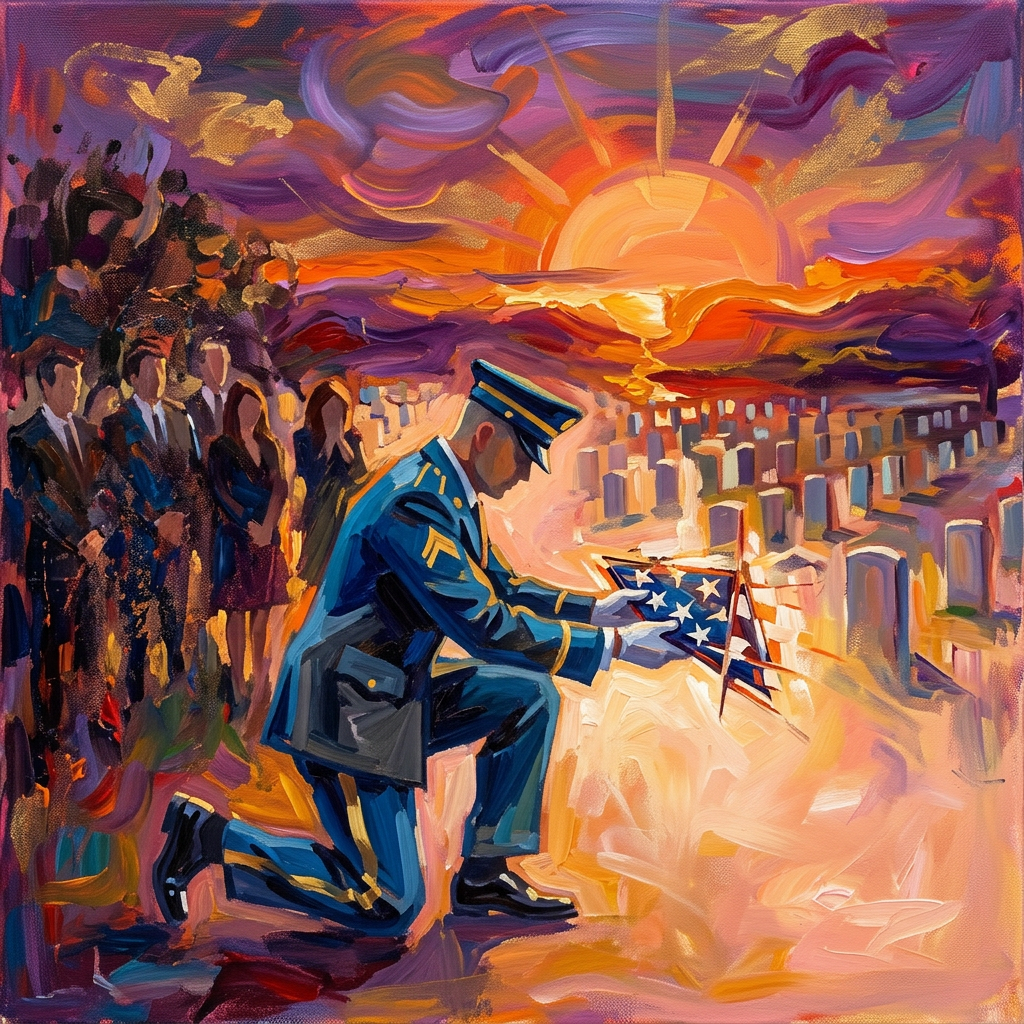
The plot, according to the deed, was in one of the older sections of the cemetery, under the cypresses for which the place had been named. It was of the kind that permits the burial of cremated remains beneath a stele. Roger had also inked, in his careful hand, an outline of the marker he wished to be set there. It was modest, with no inscriptions specified beyond his name, the dates of his birth and death, his rank, and his armed service branch. He had left the space for a personal inscription blank, and I surmised that it would befall to me to choose it. The second was a statement where he set down his wish to be cremated and buried according to Shinto rites, signed at the same funeral parlour in San Francisco as the first sheet had been signed at. It included a sketch of the urn, which was simple and made of unfinished pine, ordered from a maker in Mendocino whose work he had liked; the receipt was paid. The next item on the set was a request for a military detail, specified with the precision of a man who had once filled out forms of this kind for younger men: a firing party of seven, a live bugler, a flag-folding team, and a request that the flag, once folded at the graveside, be presented to his designated next-of-kin, along with a DOD letter approving the military honours.
The fifth document was a list of mourners. There were ten names in it: mine and Amy’s at the top, then Marcus, Evelyn, Thomas, and Michael. Then the names of Mei and Helen, and two names I did not recognise: José Garza and Joseph Rourke. Beside the first, Roger had written US Army, 9th Inf Div, Dinh Tuong, 1968, and beside the second 3rd Marines, Quang Tri, 1969, in the same careful hand he had used elsewhere.
The last document was a letter.
The envelope was unsealed. It bore my name on the front in his hand, the hand I had first learnt to read in the margins of his Anabasis, when I had been eighteen and he had been forty-six and the world had been a smaller and a much harder place. I opened it. The letter was brief. It was perhaps fifteen lines long, written on the same plain notepaper he had always used for correspondence, and the date at the top was the spring of last year, the same spring in which he had initialled the directive. I read it.
Dear Anne,
Your standing task remains as I gave it to you in 1992. You have done well by it. Keep on doing it.
The plot at Cypress Lawn is large enough for three. I have not assumed; I have only made it possible. Decide for yourself, in your own time.
Helen knows what you and I were to one another, and you know what she has been to me. Please be kind to her. She has been kind to me.
Amy is the second greatest gift of my life, after yours. Tell her so, if I do not have the chance.
You have always made me proud of you for the whole of your adulthood. I am proud of you now.
Live well,
R.
I read it once, and then again, and the second time the room and the letters on the page wavered in a way that they had not before; I had begun to weep, in the quiet and ordinary way I knew I would between now and the end of the work he had committed me to. I did not wipe my face. I let the wet lie where it was. I closed the letter, put it back in its envelope, and held the envelope on my lap for a moment with my hands covering it.
Amy, beside me, had not moved. She had let me read. When she saw that I had finished, she shifted toward me and lifted her hand to my cheek. Her thumb came away moist, the way it had in the bedroom doorway on Friday afternoon. She did not say anything. She let her palm rest on my cheek for a moment, then drew it down to my jaw, took my hand in hers and held it.
“Anne…”
“…I-It’s all right, love.”
“It is not all right, and it’s okay. Will you tell me what is in the folder?”
“… I will… but first… you should read this letter.”
“… Okay.”
I gave her the letter he’d written to me. She read it, and, when she finished, I felt her fingers tighten around mine; she then went very still, in the way she does still when she’s deeply moved. After a moment, with her face turned a little away from me so I would not see her eyes, she said, “…I, I will thank him… when you feel it’s okay.”
“You may, when you go in next. He will not want a scene, though.”
I then told her what was on the folder. When I had finished, she said only, “He thought of everything.”
“He always did.”
Amy and I comforted each other for a moment; then, when I could trust my voice, I went back to him, carrying the folder with me. I sat at the edge of the bed where I had sat the day before, and I waited until his eyes opened.
“I have read the folder, Master,” I said.
“… Good.”
“There is nothing in it I would change.”
“… Good.”
“Mei and Helen… they have both been kind to you.”
“Yes.”
“I am glad.”
“… So am I.”
I touched his hand and held it in mine. We stayed that way for a while. After, I said, “I’ve decided. Amy and I will rest at Cypress Lawn, by your side.”
“… You did not have to… decide that today.”
“It is one less thing for me to do later.”
He smiled that small, dry smile that he had used for the whole of the time I had known him, the one that meant he had heard in me the cadence he had himself put there and was permitting himself the small private pleasure of recognising his own work.
“… Yes, Doctor.”
We did not say anything else. I rose, kissed his forehead and went out, with the folder in hand and eyes still moist with the tears I’d shed and did not care to wipe away.
Chapter Six — Mei
She came in on a Tuesday morning, at 9 AM sharp.
I knew the day was a Tuesday because I had marked it on the small calendar Amy had pinned to the inside of the kitchen cupboard, and because Mei had been due since Roger had mentioned her three days before. I had not been certain, until the moment her key turned in the lock, that I would know how to introduce myself as she came in. It was Roger’s flat, after all, and I was standing in his kitchen. The manner in which I should greet a person who had been coming through that door for six weeks before I had come through it again was something I had not considered. I was at the sink, washing the breakfast cups, while Amy was at the kitchen island, dicing an onion for the soup that would be our lunch. In the bedroom, Roger was awake but resting; I had checked on him earlier, and the cannula, the concentrator, and the small, careful order of his nightstand had been in the configuration I had set up the night before.
The key turned and the door opened. The woman who came through it was perhaps thirty-six or thirty-seven years old and her hair was arranged in a low bun that sat at the nape of her neck. She carried a canvas shoulder bag of the same kind Amy did, was slender and small, almost minute, and moved without sound, in the way of a person who had been trained to do so. She paused in the small space inside the door, with her hand still on the doorknob, and looked first at me, and then at Amy. Her face softened a degree at the corners of the eyes while the rest held itself still, in the way of a face that had been required, more than once, not to embarrass another person in a doorway.
“You must be Dr Anne Marquez and Amy,” she said.
I nodded and said, “Yes, and you must be Mei.”
Mei bowed her head. She said, “Pleased to meet you, Doctor. Please, excuse me,” and stepped in.
That was all. She closed the door behind her, set the canvas bag on the small table where the rotary phone kept its watch, and put her keys in the dish where Roger’s had always lived. She crossed to the kitchen without ceremony and put her hand briefly on Amy’s shoulder, then on mine; it was the touch a colleague gives to another colleague at the start of a shift, professional and brief, and not without warmth. We did not embrace. There would have been no purpose in it.
“How is he this morning?” Mei asked.
“He’s stable. The night was long, but uneventful. He had a breakthrough at three and took a single dose of the fast-acting analgesic.”
“What’s his saturation like?”
“Eighty-seven on the cannula at four. Eighty-nine when I checked again at six. He has been sleeping since seven.”
“Thank you. Please excuse me, I will go visit him now.”
She did not ask me to come with her. She had been coming through that door for six weeks, and the standing I had now, though medically more important, had not displaced the personal standing she had earned. I went back to the cups, and Amy to the onion. Through the bedroom door, which Mei had left ajar behind her, I heard the small, soft exchange of two people who had a private greeting and a shared vocabulary. I did not listen for the words. Instead, I let the cadence carry through and tell me what I needed to know, which was that Roger was glad to see her, and she him.
She came out perhaps twenty minutes later. She held a small, leather notebook in which she made her shift notes, and sat across from me at the kitchen island to give me her report in a clinical, but generous voice. The dyspnoea was a degree worse than the previous Friday. The peripheral oedema was unchanged. He had not eaten anything beyond the few spoonfuls of the soup at his bedside since Sunday morning and had lost three pounds since her last set of measurements. The skin over the sacrum was beginning to thin in the way I had been afraid it would, so Mei had repositioned him to take some pressure off it. She had also reordered the morphine, the fast-acting analgesic, the antiemetic, and the benzodiazepine, with refills at a nearby pharmacy; she would have had Helen sign it, but since I was now the primary care physician, she would have me sign it instead.
“Thank you, Mei,” I said.
I signed the prescription, then took her notes and gave her the sheet of clinical changes I had made since Friday, in case she wished to see them; she read them with the quick competent eye of a nurse who had managed many such sheets, then handed it back to me without ceremony.
“Thank you, Miss Anne,” she said.
We sat for a moment with the kitchen between us, and the soup beginning to scent the air, and Amy at her work at the far end of the island. I had been ready for the meeting to be more difficult than it was. The territoriality I had been told not to indulge had not had occasion to surface; the territoriality Mei might have shown had not surfaced either; what had passed between us, in the small interval of report and counter-report, had been the recognition of two professionals who had been formed by the same hand and could do their work together because of it. She set her pen down. She lifted her tea. I lifted mine.
“He has shown you the folder,” she said.
“Yes.”
“He was waiting to. He would not let me see it.”
“He has named you in it.”
“I know.”
“I am glad.”
“So am I.”
She drank a sip of tea. Then she said, very quietly, “Has he specified the personal inscription on the stele?”
“He has not. He left that to whoever would settle it.”
“To you, then.”
I cradled the chipped cup between my hands. “It seems that way, though I don’t know what would be appropriate.”
Mei nodded and did not answer at once, but drank another sip of her tea, and after a moment, she said, “Would you like me to help you think about it?”
“Yes, Mei, please. Thank you.”
I rose and brought back the folder. I placed it on the counter, opening it to the plot map. Mei traced the space Roger had left blank for the personal line, then said, “There are conventions for personal inscriptions in Japanese, Miss Anne. I can walk you through them, if you would like.”
“Please do.”
She walked me through them in her small, even voice, telling me about the option of a family stone, with the family name on the front face; she told me that for Roger, who had no surviving Japanese family, this convention would name a lineage that ended with him, and that she was not certain it was the right choice. She then covered the appropriate Buddhist inscriptions, which would not apply to the Shinto rite Roger had chosen. Lastly, she told me about the Shinto convention of mitama, the term for the honoured spirit of a deceased person, which could appear alone on the stele as the inscription that named what the rite was for. She told me that mitama was austere and that Roger would not object to that.
I listened. When she had finished, I said, “Mitama, then?”
“Yes, that would be my counsel.”
“Then that is what we will put on the stele.”
I closed the folder. After a moment, she said, “I will telephone a stonemason this afternoon, if you would like. I know one in Japantown who works in both languages.”
“Yes, please. Thank you, Mei.”
“Thank you, Miss Anne. He would have wanted you to ask.”
We sat with that. The kitchen continued its small mechanical sounds. Amy, at the far end of the island, had not interrupted, and had not pretended to not be there; she had stayed in the small precise role she had learnt over sixteen years of being present without being heard, and the kitchen had received her there in the way kitchens receive Amy. After a moment, Mei slid the file back across the island toward me.
“Anne?”
“Yes?”
“Thank you, for asking me about the personal message.”
“Thank you, Mei, for caring for him as well as you have been.”
She rose and put her cup in the sink. Then, she put the small leather notebook back in the canvas bag, looked in once more at Roger, who was sleeping, and went to the door. At the door she stopped, turned, and said, “I will be back on Friday. Please call me before then if you require it.”
“I will.”
“Good.”
She went out and the door clicked shut behind her. The flat held the small quiet that follows the departure of someone whose presence had been a register one did not realise one had been keeping until they had left.
The days after Mei’s first visit settled into the rhythm she and I had agreed on. Helen telephoned twice; Mei came on Friday and on the following Tuesday. The dosages went up by small increments, in the careful sequence the work required. Roger ate less and spoke less. The intervals between the times when his eyes were open and the times when they were not lengthened in the ways I had read about in textbooks and seen in the practices of other physicians and had now to read again, in the body of someone I had loved like a father for forty years, in a flat in which the furniture had not moved in the same forty years.
Amy did the cooking, the laundering, and the housekeeping. She also, without my having asked her to, took on one of the small rituals that Mei did: the heel-and-elbow lift to relieve the sacrum, every two hours during the day. Mei had taught it to her on the Friday of the second week, in the bedroom, with Roger awake and making the small dry observations that the lesson had earned from him; Amy had learnt it the way she learnt everything, by paying attention, and had executed it from then on with the careful tenderness she brought to everything she touched on his body. I watched her do it twice, and then I let her do it unsupervised from there onwards, fully confident in her competence.
I rang the cemetery. The man at Cypress Lawn had Roger’s file and was unsurprised by the call; he had been expecting it for some months, in the way men in his line of work expect calls. I confirmed the personal inscription Mei and I had settled on, in the spelling Mei had given me, and I confirmed the cremation, the urn, and the date that we would in due course agree on. The conversation took eleven minutes. I made notes in the small leather book Amy had given me for the purpose.
There was an evening in the middle of the second week that I want to set down, because what passed in it has stayed with me when other evenings of those weeks have not. I had been at Roger’s bedside for perhaps an hour. He had been sleeping for the last twenty minutes of it. I had not moved, because I had not yet decided whether I was sitting in bed with him or in the chair next to him, and the difference, although small, was one I had not been ready to make. The lamp made its light cone and the concentrator hummed. Amy came to the doorway and stood in it without speaking, the way she had stood at the threshold on the Friday afternoon I had first brought her in. After a moment, she crossed the floor in her stockinged feet, came to the side of my chair, knelt beside it, and put her head on my knee. She did not say anything: there was no need to.
I put my hand in her hair. We stayed that way, the three of us, for what I would guess was twenty minutes: Roger asleep in the bed, myself, sitting in the chair beside it, with tears that I had stopped wiping days before, and Amy on the floor, with her cheek on my knee. The flat was very quiet. The bookshelves in the front room held their books. The chipped cup was on the shelf in the kitchen, along with the unchipped one. After a while, Amy lifted her head and stood up without using my knee for leverage so as not to disturb Roger. She looked at me and, very softly, she said, “Come and eat, love. He’ll be all right for half an hour.” I went with her and ate what she had made me. When I came back to the chair, the man in the bed had not moved, and the concentrator was still humming. I sat back down.
In the evenings, after the house had settled, I read at Roger’s bedside. He had asked me, on the Wednesday of the second week, to read aloud. I had asked him what he would like me to read. He had said, in the half-voice that was now his only voice, to read the Anabasis to him. I had taken his annotated copy from the shelf, the copy he had handed me forty years before, and I began reading at the chapter where Xenophon, having taken the command of the Ten Thousand after the murder of their generals, addressed the army for the first time. I read perhaps three pages a night, in the slow careful pace the text required. He did not always stay awake for the whole of it. Sometimes I read two pages and looked up to see him fast asleep. On those nights I closed the book, set it on the bedside table and turned off the light before turning in myself. Other times he was awake to the end and, more rarely, was even able to make one small dry observation on the translation. I then marked the place with a bookmark and closed the book.
During the third week of our stay, I read him the paragraph in which Xenophon admits that he is younger than many of the men he is addressing and asks for their trust without having earned it because there is no other way out except forward. Roger let me finish the paragraph. Then, he closed his eyes, opened them and he said, with the small effort the words now cost him, “… He is right… about the road.”
“Yes, Master.”
“… Read… the next paragraph.”
I read it. He listened. When I had finished, he said, “…Good night, Anne. Go… Sleep.”
“Yes, Master.”
I closed the book, set it on the table and turned off the light.
The next evening, after Mei had gone home and Amy had taken her place in the front room with a book, I sat with him in the bedroom. The lamp on the bedside table was on; the rest of the flat was in dusk. Roger was awake. He was looking at me without urgency, the way he had been looking at me since 1987.
I had been carrying in my mouth the name I had been reading on the documents in the folder for two days. I had not yet spoken it, so I decided I would speak it now.
“Shigeru-san.”
He did not answer at once. His eyes did not change in any way I could have named, and yet they had changed; I knew it without being able to describe it.
“… Hai. That… is also my name.”
I reached for his hand. He turned his palm up to receive mine, the way he had at the kitchen table when I had finished going through the folder. We sat that way. The lamp held the small circle of its light. Amy, in the front room, did not interrupt and did not pretend to not be there. Tears welled in my eyes. Roger did not say anything else, because there was nothing else that needed saying.
The room held us.
I did not move my hand from his for a long time.
Chapter Seven — Lethe
The third week of our stay went by without discontinuity in my memory, which I think is how time is supposed to behave in a sickroom in which the work of attending to the dying is being done with discipline. Mei came on the Tuesday, made her notes, and adjusted the morphine by a small increment, in the way I had agreed to. Helen telephoned on Wednesday; we spoke for nine minutes about what the chart was showing us and did not speak about anything else. Amy continued the heel-and-elbow lifts, prepared small bowls of soup he barely ate, and made him tea he barely drank.
I read by his bedside in the evenings, two pages now where I had read three before, because that was what Roger could stay awake for now. He spoke three- or four-word sentences, thanking Amy for the soup, naming the room temperature as too warm or too cool, and Amy adjusted the throw at the foot of the bed accordingly. Once, on a Wednesday afternoon, he said, in his half-voice, “… The rate… is twenty-eight,” and I confirmed the rate at twenty-eight without contradicting his observation, because he had once been a man who counted his own breath against a wristwatch, and was apparently still that man.
He had a crisis on a Friday afternoon, perhaps an hour after Mei had left for the day. She had finished her shift in the regular way and given me her notes, refilled the syringes with morphine, repositioned Roger one last time, and gone out. The afternoon had been quiet for perhaps forty-five minutes. Then his breath changed.
I was in the front room, at the kitchen island, when I heard it. Amy was on the couch with a book in her lap and her thumb on the page she had stopped at some time ago. We both heard it together, because Amy had been listening for it as long as I had been listening for it, in the way the household had been listening for everything for the past three weeks. The change in the breathing was not a stop; it was a sudden labour, the kind of labour that means a man’s lungs have decided that the ratio of work to oxygen is no longer favourable, and that he is going to have to spend the next several minutes paying for air he is not certain he will get.
I went into the bedroom, walking at a quick pace. Running would not have helped him and would have made me a worse doctor than I needed to be for the next several minutes. Roger’s eyes were open. He was looking at the ceiling. The cannula was in place. The concentrator was running. The respiratory rate was thirty-six and rising, with active recruitment of accessory muscles at the neck and the suprasternal notch that means a body has begun to recruit muscles that are not normally part of breathing.
I sat on the edge of the bed. I put my hand on his wrist, where the pulse was. I did not look at the watch, because I had at this point in my career stopped needing the watch for an estimate I could make against the rhythm of my own pulse, and I made it at perhaps one hundred thirty.
I took the decisions that I needed to take.
I drew up a single milligram of morphine. It was what Helen and I had agreed would be the breakthrough increment for a moment of this kind. I gave it intravenously through the catheter Mei had set in his forearm on the previous Tuesday for exactly this contingency. I adjusted the cannula by half a millimetre but did not raise the air flow or call for an ambulance. I called Mei, informed her of what was happening, sat on the edge of the bed with my hand on his wrist, and waited.
Amy was at the doorway. She had not crossed the threshold without my asking, the way she had not crossed it the Friday afternoon when I had first brought her in. She was watching me. Her hands were folded on her lap in the position I had taught her years ago for waiting in a room that was not ours.
The minutes that followed were the longest of any I have lived through in twenty-six years of practice.
I have been at bedsides where patients fiercely clung to life and, at last, after hours of suffering, sighed their last and not breathe again, and I have been next to patients that were there a moment and not there the next. The discipline that has carried me through those minutes in other people’s homes, though, was not what carried me through this crisis. What did was something older than my profession. It was the hard truth that Roger’s wishes were clear, and that the only way I could honour them was to sit on the edge of the bed and not pick up the telephone to call in transport to a hospital.
His rate slowed at about the eight-minute mark. I felt it in his wrist before I saw it in his breathing. The accessory muscles relaxed by degrees and the recruitment quieted. The colour of his cheeks, which had gone an ashen shade I feared, returned to the paleness that had been its baseline for the past several weeks. His breathing was still wet and small, but it was there.
Roger closed his eyes. Then, in the half-voice he had not had for any of the previous several minutes, he said, “… Thank you… Doctor.”
Tears stung my eyes and welled at their corners. I don’t remember feeling them as they rolled down my cheeks. I stroked Roger’s snow-white hair and said, “You need to rest now, Roger.”
“…Yes, Doctor.”
He closed his eyes and fell fast asleep.
I stayed with my hand on his wrist for perhaps another ten minutes, until I was certain that his heart rate had returned to normal and that his breathing had stabilised. Only then I rose. The tears on my face had reached the corners of my mouth. Amy was still at the doorway. I crossed the room to her without speaking; she stepped back into the corridor, I came out, and she closed the bedroom door behind me without making a sound; then, she hugged me, and I hugged her back.
I did not weep. I had not yet allowed myself to do so, though there had been times where I had been close to collapsing emotionally. There would be a time for that, later; for now, that hour had not arrived yet, but I did let her hold me, in the corridor outside the closed bedroom door, for as long as I needed to be held.
The reading that evening was the last full one I did for him.
I went in to him perhaps three hours later, when the light at the high windows tinted the sky in hues of old brass. Amy had set out a vegetable soup that none of us would eat much of.
Roger was awake.
The crisis had marked him. His face had been a steadfast mask of stoicism and composure for thirty-nine years, now, that mask had cracked: there was a small but evident downward pull on the corner of his eyes, and his lips were now lower on one side than on the other. Roger had gone through something he had never faced before, and I could see that getting through that hour had cost him a significant margin of strength, which he was not going to recover.
He looked at me as I came in.
“Read… The Anabasis… please,” he said.
“Yes, Master,” I replied.
I took the book from the bedside table and sat at the edge of the bed where I had sat for the past three weeks. I opened the book at the bookmark, set on the page upon which we had stopped the previous Monday, and prepared to read.
“… Skip… ahead,” he said.
“How far?”
“… The… sea.”
I knew the passage he meant. Every reader of Xenophon knows the passage. After the long march through Anatolia, the Ten Thousand come at last to a high pass, and a cry goes up at the front of the column that the rear of the column does not understand. That cry passes back along the column from man to man until at last the rearguard, which is Xenophon’s own, hears it in its full form:
“Thalassa! Thalassa!” The sea! the sea!
The march is over. The sea is the gateway back to Greece.
I did not want to read it. I had been hoping, against the trajectory of what I knew, that we would arrive at the passage in the slow careful pace we had been keeping, and that I would read it to him on a Wednesday or a Thursday in the manner he had taught me to read it. He had asked me to skip ahead. I understood what skipping ahead meant. I sat for a moment with the book on my lap, tears on my face and feeling my throat catching in the way it does when one is being asked to do a thing one would prefer not to do for someone one cannot deny.
“… Anne?”
“… Y-Yes, Master?”
“… Read.”
I read the moment of the cry going up and the rear thought that the front had encountered an enemy, and the passage when at last the Ten Thousand come up to the pass and see, below and ahead of them, the long blue line of the Black Sea, embrace one another and weep. Roger listened, and his eyes did not close.
When I had finished the paragraph, he did not ask me to read the next one. He said, in the half-voice, “… Thalassa.”
“…Yes, Master.”
“… It is good… to come to the sea.”
My voice cracked. “… Y-Yes, Master.”
He looked at me for what was perhaps a full minute. He smiled that small, dry smile of his, the smile he had given me for the whole of the time I had known him, the smile that meant he had heard in me the cadence he had himself put there. Then he closed his eyes.
He did not speak again from that day on.
Saturday and early Sunday passed in the manner that the last days of a long illness pass. Roger drank water from the small spoon Amy held for him. He did not eat and did not keep his eyes open for more than a few seconds at a time; when he did, he did not seem to register the room, although I could not say with certainty that he did not. I sat at the bedside in the chair. Amy did the work of the household. Mei came Saturday morning, on a shift she was not scheduled for, because she had telephoned me the previous evening and I had told her where we were. She did not need me to say more than what I had said.
Mei did her work and made her notes. She did not speak to me of what we both knew. Before she left, she stood at the foot of the bed for a moment, with her chin lowered, and she said something to him in Japanese, which I did not understand and did not ask her to translate. Then she went out.
Helen telephoned that afternoon. We spoke for perhaps three minutes. I told her what I had seen. She told me what I expected her to tell me, which was that there was nothing more for either of us to do that we were not already doing, and that I should call her when it was done. I said I would. We set the receivers down.
I read at Roger’s bedside that evening. I did not know if Roger heard me. I read a page and a half of the Anabasis from the place we had left it when he had asked me to skip ahead anyway, because I did not want him to die without my having finished the chapter we had been reading together, even if his ear could no longer follow it. Then I closed the book, set it on the bedside table and turned off the light.
Roger was breathing in the small wet way he had been breathing for the last day. His eyes were closed. He had not opened them for the whole of the reading, and I did not know whether he had heard me. I had been told, by Helen, in one of the conversations we had had in the previous week, that hearing is the last sense to go; that a person at the threshold who can no longer respond can often still hear; that whatever one has to say to such a person should be said.
I had something to say. I had to ask Mei about how to say it, because I did not know how, and I sure as Hell did not want to say it wrong. It was… too important to say wrong.
I leaned forward in the chair. I put my hand on his hand, which was on the coverlet. I spoke in the voice I had used in the lamp-lit bedroom on the evening I had spoken his name; the voice that reached for the language his mother had spoken to him.
“Arigatō gozaimasu, Otōsama.”
He did not respond. His breathing kept coming in its small, wet rhythm. I did not know if he had heard me. I told myself that the point of my saying what I said was besides the fact of whether he had heard me or not. Something was owed, and that something was now spoken.
I sat with my hand on his for a while longer. Then I turned out the light.
He died at perhaps seven in the morning. I was in the chair. The sky had begun to come up pale beyond the high industrial windows, and the kitchen was quiet because Amy had not yet risen, though I knew she had not slept much and was not really sleeping. My hand was on Roger’s wrist in the way it had been for much of the previous night.
His breathing was very small. I had been counting it without intending to, in the unconscious way one counts a metronome. The interval between one breath and the next had been lengthening for some hours, by small increments. I understood, as the intervals stretched, that my work was nearly finished, and that what remained to be said had to be said now or not at all.
I leaned over him, took his hand from the coverlet and held it in both of mine. I spoke into the small space between his ear and my mouth, in the voice I had used the night before, but in the language that we had shared for forty years.
“Thank you, Father.”
His fingers, in my hands, gave the smallest squeeze. That was all his strength still permitted. It was not much, but it was… enough. Then, he sighed. It was the sound of a man who had at last finished what he was here to do.
His chest stayed low and did not rise again.
I did not move at once but stayed with his hand in mine. The pulse, which had been thready for some hours, had ceased. I noted the time on the wristwatch I had inherited from my mother. It was seven minutes past seven.
There was nothing else to do.
I rose from the chair, bent over him, kissed his forehead, which was still warm, and shrouded him, covering his face with the blanket.
My eyes stung, and my chest felt as if it were being crushed.
I left the room and closed the door behind me.
In the corridor, Amy was waiting. She had risen at some point in the previous half-hour, awakened by some change in the rhythm of the flat that had reached her in her sleep. She was in her dressing gown and barefoot, watching the door I had just closed.
She was waiting.
I did not have to tell her. She read it in my face before any word I might have said. She walked over, hugged me, and held me. The strength I had saved for the last moments ran out in her arms.
I wept into the shoulder of Amy’s dressing gown, without restraint, in a way I had not done since that afternoon in the basement back home, on the third anniversary of Julia’s death. Amy held me, herself weeping, while the high industrial windows went on doing their work of letting in the growing morning light.
After a time, she said, very softly, “… I… I’ll… go make some tea.”
“… T-Thank… thank you, love.”
“You sit, love. I’ll be back.”
I nodded and sat on the ground.
She did not let go all at once. She held me for another moment and stepped back. Her hands clung to me for a few moments and, though I felt shattered into a million shards of pure sorrow, her touch comforted me. Then she turned and went into the kitchen, dabbing her eyes. As I sat down on the floor of the corridor, with my back against the wall, opposite the closed bedroom door, I wept again as I waited for Amy to come back to me.
Chapter Eight — Rites
I do not remember the rest of that Sunday morning very clearly. I do remember Amy bringing me tea on the floor of the corridor where I had been sitting, and her sitting down on the floor beside me with her own cup, and the two of us drinking the tea against the wall opposite the closed bedroom door, in the slow quiet of the morning, without speaking. I also remember her getting up at some point and making the calls I had told her to make; she made them from the rotary phone in the front room, in the half-whispered voice one uses to tell people on the other end of a telephone that the man one is calling about has died. She called Helen first, because she was the doctor of record on the case and would have to sign the certificate. Then, she called Mei and the funeral home that Roger had chosen. The next calls were mine to make, but I was not yet ready to make them.
I do not remember rising from the floor of the corridor, but, at some point, I did, because I found myself at the kitchen island with the green folder open in front of me and the documents laid out across the surface in the order in which I had read them three weeks before. I had thought, in the scatter-brained manner one thinks when emotion overwhelms logic, that I should reread what Roger had given me, in case I had missed something that was now needed.
There was a lone envelope in the folder that I had not looked at on the first reading. It was small and made of the same plain notepaper Roger had used for his correspondence, tucked between two sets of documents where I had not been looking for it. It bore the name “Mei” on the front, in his handwriting.
I held it for a moment. Then, I closed the folder around the other documents and set the envelope on the kitchen island, so that it was visible to whoever next came into the room.
Mei arrived at about eleven in the morning. She came in without ringing the bell, because Amy had told her on the telephone that the door was unlocked. She wore a dark grey jacket, and her hair was in the same low bun I had grown accustomed to seeing.
She stood at the threshold for a moment in the way she had stood there on her first arrival and crossed to the front room without going first to the bedroom. She came to where I was standing at the kitchen island. Her eyes were puffy and reddened.
Mei put her hand on my forearm. She did not say anything. There were no words. I nodded in silent thanks, and she softly smiled, acknowledging. Her hand stayed for the length of one breath of mine, and then she withdrew it.
“… T-There is an envelope for you, Mei,” I said.
She saw it, picked it up, held it for a moment in the same way I had, and opened it. She then read the letter in it twice, in the way one reads a letter whose contents one wants to be sure of, folded it back into its envelope, leaned on the counter, and sighed.
As she did so, Mei’s hands trembled a little and her eyes welled up with tears. I reached for her hand and lightly squeezed it. She said, “It’s… a letter saying that if you do not feel comfortable with the funeral he wishes, you can organise a Western one for him. I… can see why he’d say that; Shinto funerals are… very different from Western ones, and some could find them… disturbing.”
I absorbed this information in silence and nodded.
“I… loved Roger,” I said, “and I will honour his wish for the funeral he wanted. What is required?” I asked.
Mei nodded and looked at me with newfound respect in her eyes. “A Shinto priest will need to be brought from Sacramento. He will perform the tsuya, the wake, here at the flat this evening, with Roger’s body present and dressed in white within the casket in the front room. The tsuya runs from evening to morning. Tomorrow morning the body will be taken to the crematorium for the kasō-sai, the cremation rite, and after cremation there is the kotsuage, lifting Roger’s bones into the urn with chopsticks. That part is for family only.”
I was surprised by the gruesome detail of handling the bones of a deceased person, but took it in stride; I asked, “… A-and then?”
“Then you take the urn for burial at Cypress Lawn whenever the cemetery and the military funeral detail are ready.”
“What is the dress code for the mourners?”
“You, Amy, and I will need to wear white kimonos throughout. I will help you find the kimonos; I have done this before.”
I nodded, absorbing the information with acceptance. Roger’s mother had brought with her a Japanese tradition that called for mourning in white generations before black became the norm. Roger had inherited that tradition from her in the same way he had inherited the language. The white clothing was a thin thread of continued tradition passed on from a woman I had never met to honour a man’s passing according to his culture.
“If you can trust me, I will arrange everything.”
“I trust you.”
I spent the next minutes listening to Mei navigate the arrangements for a funeral rite that I was only now starting to understand in its heft and involvement. It terrified me to have to handle Roger’s bones, but I owed him that much to do my best to honour him in death as I had respected him in life.
When she was done, about forty-five minutes later, Mei looked sombre but composed. “It’s been all taken care of,” she said. “The funeral home will take Roger’s body in an hour, prepare it, and bring it back here in the evening, in the casket the priest has approved. The wake begins at six. The cremation is Monday at ten, at the crematorium in the south of the city.”
I lowered my head, still taking in all the information; then, I put a hand on Mei’s shoulder and gently squeezed it. I was realising how invaluable it was to have her as a resource for the next two days; in a way, access to Mei’s expertise was not unlike having a specialist to consult about a pathology I was unfamiliar with.
“Thank you, Mei,” I said.
“My pleasure, Dr Marquez.”
Then, she went into the bedroom and stayed there for perhaps fifteen minutes. I did not know what she did in there, and I did not ask her when she came out. I surmised some of it would have been the small tasks any nurse practitioner performs for a body that has not yet been collected by the funeral home, and some of it would have been her own farewell, in the language she shared with him, in a privacy I was not entitled to interrupt. When she came out, she had in her hand the small leather notebook in which she had been making her shift notes, and she set it on the kitchen island in front of me, and she said, “These are yours now. He would have wanted you to have them.” Then she placed the envelope over the green folder and stayed with us for a while. Then, she went out with the promise that she’d return.
The funeral home arrived shortly thereafter. They came in a small dark van and took Roger out of the flat in a gurney covered by a white sheet.
Mei returned after the funeral home had taken Roger away. She had brought with her two white kimonos for us. I appreciated their essential purity and my mind wandered, meditating on the reason why Roger had chosen white for us mourners to wear instead of black.
Black is a colour that has presence. It is unavoidable and unmistakable because of it. White is also unmistakable, but one notices it because it is a chromatic irony: White’s presence is powerful because as a pigment it is an absence of colour, and it’s not a long logical stretch to see how that could also stand for the absence that a loved one’s departure leaves.
Amy had never donned a kimono before, and neither had I. Mei helped us to wind our obi, explaining what she was doing with kind, instructive patience; then, she wound hers.
The funeral home returned Roger to the flat at about three that afternoon, laid in a plain, unfinished cedar casket, and they set the trestle in the front room, where the long couch had been; Amy, Mei and I had moved it against the kitchen wall to make room.
Helen arrived at around four, dressed in a white cotton dress of her own. Amy busied herself to manage the logistics of having people over, people who in the next hours would need food and drink for sustenance.
By half past five, the flat had become a room in which four living people and a dead one shared a common void.
Roger was dressed in a pure white kimono Mei had bought. His hands were composed at his waist, and I noticed that he looked younger than he had looked for the past several weeks.
The Shinto priest arrived at six. He was a man about my age, dressed in the dark grey robes and headdress this occasion required. He bowed to me at the door and offered his condolences in fluent English. “You must be Dr Marquez,” he said. “Roger spoke warmly of you.” I bowed back and thanked him for coming. He then moved past me to the trestle and set up a small altar at the foot of the casket; Mei helped him, in the low voice of two people who shared a language and a work but no history. The altar held a small mirror, two candles, and a tray of sakaki branches, the evergreen branches from which the white shide paper had been folded and hung.
The priest chanted in the formal Japanese of the Shinto liturgy, whose cadence is used for nothing else in modern speech; Mei, standing beside me, said the responses. I did not understand the words, but I did not need to: the cadence led me. There was a moment when the priest extended a tamagushi branch to me, and Mei whispered to me what to do with it; I took it, bowed, turned its small hilt twice in the manner she had described, and placed it on the altar with the stem facing the casket. Amy did the same after me. Helen did the same after Amy. Mei did it last and stood for a moment with her hand on the altar before she stepped back.
When the priest finished the rite, he bowed first to Roger, then to the altar, and then to the room. He came to me at the door, where he bowed again and said, very quietly, “May he rest among his ancestors.” I thanked him. Mei went down the stairs with him to the door of the building, and I heard the front door close some moments later.
Mei returned. We stood in the room for a while afterwards. None of us spoke much. Helen came to me and hugged me briefly; then she stepped back and said, in the small even voice I had come to know on the telephone, “He… He was a good man, Anne.” I said, “… Yes. Yes, he was.” She nodded and did not say more. Meanwhile, Amy had set out tea and some small, white, paper-wrapped sweets that Mei had brought. In the meantime, Mei cooked some rice, set it on a bowl, and put a pair of chopsticks upright into it before placing it near the coffin.
Amy and I sat on the long couch; Mei and Helen on the kitchen stools. We changed seats often, talked about Roger, and about us and our relationship to him, as we kept vigil through the night. At around midnight, we took off our kimonos and lay down for a few hours of broken sleep. Helen changed out of her dress and slept with the rest of us, all uncomfortably piled up in a sofa made for at best three people. None of us could have used Roger’s bed. None of us, for that matter, could have unfolded the cot either. Frankly, it was a little embarrassing: four grown women, of whom three working in healthcare, afraid of sleeping in a bed on account of ghosts we did not believe in.
We would have never heard the end of it, but there it was.
At around seven, we woke up. We were all wary of going into Roger’s bedroom to shower and awkwardly commented about it but showered anyway. Mei ironed the kimonos and Helen’s dress. She dressed first, then helped Amy and me back into the kimonos for the cremation rite.
Monday morning came with an overcast sky and a threat of rain sweeping in from the bay. The funeral home came to take Roger away to the crematorium. Mei, Helen, Amy and I followed the hearse, riding in Mei’s car. I rode in the passenger’s seat, and Amy and Helen in the back. The drive itself took perhaps half an hour, though to me it felt like a lot longer. We kept the radio off: we had no heart to listen to anything other than the contemplative silence of our collective sorrow.
Our destination was the kind of building that exists, with small variations, in every city in the world. It was low, well-kept, had tall plantings around the entrance, and a discreet sign at the kerb in the lettering that suggested that it catered to both Asian and Western needs without committing to either. The priest had arrived before us; he was wearing the same robe he had used for the tsuya the day before.
The rite itself was brief. The priest performed it in a small room before the cremation chamber, with the casket open and Roger visible in his white kimono. We stood in a half-circle around him.
The priest chanted the kasō-sai prayers and offered the tamagushi at the small altar he had set up at the head of the casket. We each offered a tamagushi in turn, in the same order as the night before. When the rite was finished, the priest bowed, and the staff came forward and closed the casket. Then, they took Roger into the cremation chamber, and we watched the door slide shut behind him. The priest left after that. He said he would return for the inurnment. What followed after cremation, the kotsuage, was just for family.
We waited. The crematorium had a small waiting room with low couches, a tea service and a clock on the wall that I did not look at, because looking at the clock would have made the wait longer. Amy sat beside me. Helen sat across from me. Mei sat beside the priest’s empty chair. We did not talk. After perhaps an hour and a half, one of the staff came in and said, “It is time. Please come with me.”
The room he took us to was small and bright. It had white walls and a low metal table at its centre, on which the cremated remains had been laid out on a clean white cloth, in the rough anatomical order in which the staff had arranged them. There were the bones of the feet, at the end of the table nearest the door; then the bones of the legs, pelvis, ribs, and arms, and, at the end of the table farthest from the door the bones of the skull, which had been broken into pieces, so that it would fit in the urn.
The urn itself, made according to Roger’s instructions, was on a small stand at the head of the table with its lid set beside it. Beside the urn there was a small wooden box that held four pairs of long unmatched chopsticks, one made of bamboo and the other made of wood. I had never seen such chopsticks before. Mei told me, in a low voice, that those chopsticks were used only for this ritual. The asymmetry between the two materials was the asymmetry between the world of the living and the world of the dead. The chopsticks were the only objects the two worlds shared.
The staff member explained what we were to do. Two of us would lift each bone fragment together, with our chopsticks meeting on the bone between us, and we would place the bone in the urn from the feet upward, so that Roger would be upright in the urn when the work was done. The closest relative, alone, would place the last bone, the nodobotoke, because it was where the spirit of the deceased was understood to reside.
Mei and I lifted the first bones together. They were the bones of the right foot, small, curved and possibly still warm with residual heat. We lifted them between our chopsticks, my pair and her pair, with the bone held in the small space between the four points of bamboo and wood. We carried each bone to the urn, and placed it inside, at the bottom, in the position the foot would have occupied if Roger had been standing upright in it. We returned for the next bones. Helen took the next pair with Amy. They did the bones of the left foot together, in the same way; Helen’s chopsticks met Amy’s on the bone; they carried it to the urn and placed it there. Mei took the next pair with Helen. They did the bones of one of the lower legs together, in a partnership none of us had had to discuss.
The work took perhaps twenty minutes. We rotated through the pairings as the staff member directed, in the quiet undertone in which he gave his instructions, in the careful calm of a man who had done this work many times before and would do it many times after, and who understood that the people in front of him were doing it once. We did not speak among ourselves. The only sounds in the room were the soft tap of the bones against the inside of the urn as they came to rest, and the quieter sound of our chopsticks against each other when our pairs met on a bone, and the slow patient instructions of the staff member at the head of the table.
Throughout this grim ritual, I held myself together relatively well, though Amy and I had to stop a few times to collect ourselves. Mei was moved, but remarkably calm, and so was Helen. During the drive, I had questioned her about how she could be so calm. She said she had cried herself out earlier. I took this on faith and was finding it to be true. Helen’s chopsticks were as steady as Mei’s, and steadier than mine and Amy’s were. I envied them both.
Then, it was time to place the last bone. Amy, Mei, and Helen stepped back.
I felt the weight of Roger’s presence in my life bear upon me and embraced it.
He had led me out of a very difficult moment when my own family could not. That made him, in my heart, my father. That smallest of squeezes he’d given me before he died… That had told me without a doubt that the feeling was mutual. I belonged here.
I put down one of my chopsticks and held the other in my right hand, adjusting my hold so I could confidently take the bone. The staff member identified the bone for me on the cloth at the head of the table: it was the second cervical vertebra, small and complete, with the curve at its centre that gives it the resemblance to a meditating Buddha that has given the bone its name in Japanese. He said, “He was a man of the road.”
I lifted the nodobotoke with my single chopstick, against the small, curved indentation of my left palm, in the way the staff member had shown me. I carried it to the urn, which was full now, almost to the lip, with the bones we had placed in it together. I set it on the top, in the centre, where the throat of the upright Roger would have been. The bone settled. The work was done.
I put down the chopstick on the small tray the staff member held out for it. He then set the lid on the urn. He did not seal it; that was the priest’s work, later, at Cypress Lawn, after the flag had been folded over it.
The urn went into a box, and it into a small carrying case. The staff member handed it to me with both hands and bowed.
I bowed back and held the case against my chest with both hands. Then, we all left.
Amy’s face was streaked with tears; so was mine and Mei’s. Amy stopped, turned, and hugged me.
I stood with my forehead against hers, holding the case between our chests as we stood in the empty corridor, and our tears met.
After a time, she stepped back. She put her hand on the case, briefly, and nodded once. We went out, with the case between us, into the small ordinary afternoon where Mei and Helen were waiting for us in the parking lot.
Mei drove us back to the flat. Helen took the passenger seat, and Amy and I went in the back. She held the case in her lap, our hands together on its lid. The rain, which had been threatening all morning, started at last; the wipers went on, and the city wept with us that afternoon as we brought our dead back home.
Mei dropped us off in front of Roger’s flat. It was pouring, so we hurried in, carrying the case up the stairs. Amy unlocked the door and we came into the front room. The flat was unchanged. The trestle was gone; the couch was still against the wall; the bookshelves still held books; and the kettle still was on the stove where Amy had left it before we had gone out to the cremation. The cups were on the shelf in the kitchen.
I set the case down next to the rotary phone. It was the same height as the phone, and both objects, standing side by side on the small table that held them, made a small, sober pair: the man’s voice and the man’s bones, both held in their boxes.
Amy filled the kettle. I sat in the chair Roger had kept beside the rotary phone. The light at the high industrial windows had turned into shades of tin and vermeil, and the rain went down harder now. The kettle began to heat on the stove.
There would be tea. There was always tea.
Chapter Nine — Epistrophe
The weather delayed Roger’s military funeral for two more days. Amy and I lived those days in a weird suspension. Sometimes, I would peek into Roger’s bedroom, half-expecting him to still be there, hooked to the now-silent concentrator; other times, I caught myself reaching for the Anabasis, only to remember it was in Roger’s bedroom, on the nightstand, where I had left it the night before he died. Sometimes, I would say aloud to myself, “I should go check on Roger,” only to lock my eyes on the case containing the urn. It was bizarre; it was ridiculous.
It was exactly as I had reacted when Julia had died.
I called Helen often during those days; Amy, for her part, called Mei. We shared, and cried, and laughed, and we all started to slowly accept the fact that Roger was no longer among us.
When the weather finally broke, Cypress Lawn called to let us know that Roger’s funeral could proceed the next day. I called Mei to ask her if she would drive up to St Helena with Amy to get black dresses for us. I called Amy to me and told her to bring back for me the black pants tailleur, my black pumps and a white blouse, and suggested that she wear the black skirt tailleur she and I had bought for her on the occasion of one of our anniversaries. Amy would not stop recalling that drive for the next several days. I still recall vividly the first time she told me about it.
“Anne,” she said, “here is what happened on the drive. I want you to know all of it.
“Mei picked me up at nine. She had her hair down, which I had not seen on her in the two weeks I had known her — usually it was up in that low knot she always wore for work. She said it was easier to drive with it down. We pulled away from the kerb and started north.
“For the first half-hour we did not talk much. I think we were both still living inside the kotsuage and the suspension of the two days that followed, so we did not have words yet for the morning we were now in. I watched the city go by, my eyes capturing how the Golden Gate Bridge loomed with its red structure and suspension cables, how the headlands stretched in shades of grass and rock, and how the long open stretch of the 101 snaked between the hills as it went north. The weather had cleared, but the road was still wet, and the tyres were making that hissing sound that wet roads make.
“Around Novato, Mei said, ‘Can I tell you something?’
“I said yes.
“She said, ‘Roger was not just my patient. He helped me get through my mother dying during the pandemic, like he helped Anne, many years ago. I think you know what I mean.’
“I did know what she meant. I have known for sixteen years what Roger did for you, even though we have not always spoken about it directly. I know the scope of what he did. I told Mei, ‘Yes. I know what you mean.’
“She drove for a while without saying anything else. Then she said, ‘I just wanted you to know. I did not know if Anne knew about me. I did not want her to find out from someone else.’
“I told her Anne did not know. I asked her if she wanted me to be the one to tell Anne, or if she would prefer to do it herself.
“She said she had thought about that all night and said she would prefer if I did it. She said she did not have the words, and she did not want to make Anne carry the disclosure on top of everything else this week. She said: ‘You will know how to tell her. You seem to be the kind of person who always knows how to tell things.’
“That made me cry a little. I had to wipe my eyes with the sleeve of my coat, and Mei reached across and put her hand on mine for a moment without taking her eyes off the road.
“We did not talk much for the rest of the way to St Helena. But the silence was different from the silence at the start. We had said the thing that needed saying, and now we were just two women driving up the valley together, with the dresses for your funeral ahead of us and Roger’s bones behind us in the city.
“I have driven this road many times, to and from Yountville when Uncle Cyrus was sick, and to and from St Helena since I came to live with you. The valley always smells like wet earth in March when the rains have just stopped. I told Mei that, somewhere past Petaluma. She said it was a beautiful smell. She asked me how long my family had been in California. I told her three generations, since my great-grandparents came over from Umbria in the 1920s. She told me her family had come over from Japan after the war. We talked about that for a few miles, about what it is like to be the granddaughter of immigrants, what it is like to be one yourself, what stays and what goes from one generation to the next. It was nice to talk about something else for a while.
“At the house I made tea. I showed Mei around briefly, giving her a peek at the photographs of you and Julia in the front hall, the photographs of Uncle Cyrus in the kitchen, and the lamp from his estate that Mom had thought was ridiculous and that you and I hung above the dining room. Mei looked at everything carefully. She said it was good to see where you lived and said it made her understand you better. I let her look as long as she wanted.
“Then we collected the dresses: your pants tailleur, the white blouse, and the pumps; and I picked up my skirt tailleur from our anniversary, a cream blouse, and my low heel pumps.
“I packed everything carefully into garment bags. We had tea on the terrace before we left. The sun had come out, and the valley was as I had always remembered: moist, green and to bloom with the coming spring.
“On the drive back, Mei was quieter. I think she had given me what she had needed to give and the rest of the day was just returning to the city. We listened to the radio for a while, some classical station playing something Bach, I do not remember what. The bridge was crowded coming back into the city, the way it always is in the late afternoon, and we sat in traffic without minding it because we were not in a hurry to get back to the awaiting work.
“When we pulled up to the flat Mei said, ‘Please, take care of her tonight. Tomorrow is going to be a hard day for her.’
“I said I would.
“That is what happened on the drive. There is more I am still thinking about, but this is what I wanted you to know first.”
The next day, we rose at eight o’clock in the morning. Amy put on the kettle and brought the two cups down from the shelf. Slowly, the reality of Roger’s absence was settling in; I surmised it would stay with us for a long time, just like Julia’s absence had settled in for me on the first morning of being without her, eighteen years before.
I sat at the kitchen island in an oversized T-shirt that passed for my pyjamas. Amy had slept in her undergarments. Mei had called us the night before, reminding us about the dress code and that she would come pick up the kimonos.
We took our time to shower and get ready; wearing my tailleur, after weeks of wearing essentially house clothes and sleepwear felt like wearing a suit of armour.
Amy folded the white kimonos when we were done, with the careful precision of a person who has never folded a kimono before but has been shown how it was done. We set them on the couch for Mei to take later.
To make time, Amy and I talked about inconsequential stuff: whether contemporary art was worth collecting; whether the world would finally regain some degree of sanity, and whether we would see affordable fuel soon.
We also talked about Roger: how he had come into my life again; how he meant a great deal to both of us, and how long would it take us before saying his name would not make our hearts feel like they were being torn asunder.
Time goes by very quickly when one is engrossed in conversation, and the twenty minutes Amy and I thought had been talking for turned out to be four hours.
Mei arrived at about half past one. She opened the flat’s door with the keys Roger had given her and this time she left them on the counter. Amy and Mei smiled warmly at each other, and she bowed at me as she went in to pick up the kimonos.
The case was on the small table where we had left it. I picked it up and held it against my chest, the way I had held it in the corridor outside the kotsuage room. I took the keys to the flat and locked the door behind us as we left. I did not turn back to look at it. There would be time, some other day, to come back to the flat and to do what the flat would require, but that work was not today.
We drove south to Colma in two cars. Mei drove her own; we drove the Volvo estate we had brought down from St. Helena. Amy held the case in her lap in the passenger seat, with the seat belt run around it and her hand on the lid, protecting it. The early afternoon was clear the way some Bay Area afternoons in early summer are before the marine layer comes in, and the light was bright and warm. The traffic on the freeway was light.
Cypress Lawn occupies a great deal of land in the small town of Colma, in which cemeteries occupy more land than housing since the city of San Francisco stopped permitting burials inside its limits in the early years of the twentieth century. The older sections lie at the eastern end of the grounds, under the great Italian and Monterey cypresses for which the place was named, and Roger’s plot was in one of them, in a row of older vertical steles, set under a particularly venerable cypress that had grown there for a hundred years and would continue growing for hundreds more.
We turned in at the main gate. The man at the small office had been told to expect us; he gave us the directions to the older section, and we drove up the long avenue, between the rows of stones and past the larger monuments of the late nineteenth century and the smaller markers of the late twentieth. We came at last to a small gravel turn-out under the cypress and stopped.
The funeral detail and the Shinto priest were already there. The guard had set up their position at the head of the plot, in the small disciplined formation in which they traditionally set up: the firing party of seven enlisted men in their dress uniforms with their rifles at order arms, the bugler standing apart at perhaps thirty paces, and the two flag-folders at the small stand on which the urn would be set. The flag itself was folded into a rectangle and rested on the table beside the stand.
The detail’s senior NCO, a man about forty years old, dressed in the United States Army blue dress uniform, was speaking to the priest in the small courteous interval such men must have with religious practitioners at the start of a ceremony of this kind. The priest had arrived in his grey robes and headgear; he had brought with him the small altar he had used at the wake, which had been set up at the foot of the plot, in the position that allowed the Shinto rite and the military rite to share a space without contradicting each other.
The other mourners had begun to arrive. Helen was there, in a charcoal dress; two strangers had come up together, in dark suits with small brass pins on their lapels. One was the distinctive eagle, globe, and anchor of the Marine Corps; the other I could identify only as Army. I surmised these were Rourke and Garza from the document in Roger’s folder.
Marcus and Evelyn drove down from Sonoma, in dark formal clothes; Thomas and Michael had come from the city, from the flat in the Marina they had bought together a few years before. They were standing a small distance behind Marcus and Evelyn, distinctive in their long association. When I came up to them, they greeted me warmly, but something happened during that brief reencounter that told me things had changed. I didn’t register it right away, but the way that all of them addressed me was stating the obvious. I was now the head of our circle.
None of them had been to a military funeral before, but all of them had come for me and Roger, and for the small implicit acknowledgement that they were here because we had been formed, all of us in our various ways, by the same network of discipline and deep care.
I went to each of them, in turn, with the case in my arms. Marcus held me for a moment, with his cheek against the top of my head in the way he had held me at the ceremony at my home sixteen years before, when I had collared Amy in the dining room, and whispered, “Hello, Mistress.” Evelyn took my free hand, the one that was not on the case, and held it without speaking, saying, “Hello, Mistress Anne.” Thomas and Michael, together, said “Mistress” and let me move on. When I came to Helen, she simply lowered her chin a degree and I lowered mine in return.
The two veterans, when I came to them, surprised me by the formality with which they shook my hand; one of them, swarthy and tall, said, “Lieutenant Colonel Fukuyama was the finest officer I served under, ma’am,” and I said, “Thank you. He spoke fondly of his men.” It was the only thing I could think to say that would not have been a lie. He had spoken of the men he had served with in passing, whenever I visited him at his flat over the years, in the unnamed way that he used when talking about those he had cared for.
Finally, the senior NCO of the detail came to me. He introduced himself and told me how the ceremony would unfold, in the precise manner these men have. The religious rite would come first; then, the firing party would fire the volleys. Taps would be played next; then, the flag would be folded and presented, and burial would follow. He asked me whether I had any preferences about the conduct of the military portion. I said, “No, thank you.” He said, “Yes, ma’am. We will take the urn from you when you are ready.” I paused a moment, holding on to the case. My eyes stung as I looked down at what I was holding. I was finally letting go of the man who had saved and shaped me. My heart broke as I whispered, “good-bye, Father,” and offered it to him. He took the case respectfully with both hands, carried it with dignity to the stand at the head of the plot, and set it there. The two flag-folders lifted the flag, unfolded it, and held it upright behind the case.
We, the mourners, stood in a small, loose crescent at the foot of the plot, in no particular order other than having me at the centre of the group. Amy stood at my right. Mei stood at my left. Helen stood beside Mei. The two veterans, Marcus, Evelyn, Thomas, and Michael completed the crescent.
The priest stepped forward. He chanted the burial rite in the formal Japanese of Shinto liturgy, using the same cadence he had used at the wake and kasō-sai. Mei said the small responses in her low voice. He offered tamagushi at the small altar; we offered tamagushi in turn, in the same order we had used at the wake. He bowed to the urn, to the altar, to us, and stepped back.
The senior NCO gave the small gesture by which the next portion of the ceremony was to begin. The firing party came to attention. The bugler, at his thirty paces, lifted his horn.
The volleys came. Three rounds, fired by seven rifles, in the precise discipline of men who have practised this work over and over again until every movement is perfect. The first round was the one that startled me, although I knew it was coming, and for which I was as prepared as a person can be for the sound of seven rifles fired at a graveside on a clear summer afternoon. The second and third rounds startled me a little less. Between each round, the small interval of silence held the volume the rifles had vacated, and the silence was as much a part of the ceremony as the volleys were.
When the third round had ended, the bugler began playing Taps.
I had heardthat melody a great many times in my life, on television, in films, and at the Memorial Day services my mother had taken me to as a child. I had also heard it sounded in person twice, at military funerals of men I had known peripherally; but I had not heard it played for a man I had loved. The bugler played that simple melody with the careful, lengthened cadence in which a good bugler plays it. Its notes came clear across the afternoon air. The small group of us at the foot of the plot received them. Then it was over. The melody’s notes ended, held by the afternoon air as it had held the silences between the volleys. The flag-folders then stepped forward, turned the flag flat and began to fold it.
There are thirteen steps in the formal folding of a military funeral flag. Each fold corresponds to a piece of the meaning the ceremony assigns to it, and the two soldiers performed each with the small precise economy of men who could do this in their sleep and would not, on this afternoon, do it in any way other than the way it was meant to be done. The flag became its triangle, with the stars on top. The folder closer to me brought the flag to the funeral detail’s senior NCO. He received it from him with both hands, turned, and came to me.
He looked me in the eye as he said, “On behalf of the President of the United States, the United States Army, and a grateful nation, please accept this flag as a symbol of our appreciation for your loved one’s honourable and faithful service.”
He held the flag out. I took it with both hands, the way I had taken the case the day before and held it against my chest. The flag’s wool felt warmer than I had expected. That warmth felt related to him in a way I could not explain. The senior NCO held my eye for a moment longer for the time required by protocol. Then, he stepped back and saluted, the formal portion of his work done.
I kept holding the flag against my chest.
The tears were on my face since the bugler’s first note. I had not been able to wipe them during the folding and could not have wiped them during the presentation. I did not wipe them now. Amy, beside me, wept as well, quietly, looking at the flag. After a moment, her hand found my elbow and her fingers rested there, in the small unobtrusive contact that meant she was beside me and would not move from my side.
The two flag-folders, with the senior NCO, returned to their position. The detail came to attention. The senior NCO gave the small gesture that ended the military portion. The detail went off in their small clean discipline, to wait at their van until the inurnment was done and the family had departed.
The priest stepped forward again and performed the sealing rite. He took the box holding the urn out of the case; he then tied white cord around the box’s lid as the rite required, placed his hand on it for a moment, and chanted the closing words. Then he stepped back.
The cemetery’s attendants came forward. They lifted the box, carried it to the small opening that had been prepared in the earth at the centre of the plot, and placed it there. Then they covered it with soil and erected the stele. It was made exactly as Roger had specified on the plot map, and bore a five-line inscription:
福山 茂
Roger Fukuyama
Lt. Col., U.S. Army
1940 — 2025
御霊
The work was done.
We stood at the plot for a few minutes. No one spoke. The marker was new and the earth around it was newly turned, and the cypress above it made its long slow shadow on the grass to the east of the row. The priest, who had stayed for the inurnment, bowed to the marker, and to me, and went out, with Mei at his side. The two flag-folders and the firing party had gone. The bugler had gone. The senior NCO had gone. The cemetery’s attendants had gone. There were ten of us left, by the marker, in the small standing geometry of those who had loved him.
After a while, Marcus said, “Anne?”
“Y-Yes?”
“We will go now. You know where we are. Call us whenever.”
“… Yes. Thank you, Marcus.”
He kissed my forehead, a small gesture an older man could give to a younger woman. Evelyn took my hand and pressed it. Thomas and Michael came forward together, and Thomas said, “Whenever you want us, Anne.” I said, “Thank you, Thomas.” They went. Helen waited until they had gone. Then she came to me and put her arms around me, in the way she had at the wake, and she held me for the length of one of my breaths, and then she stepped back. She did not say anything. There was nothing she had to say.
She left with Mei. The two veterans had already gone, with the small, dignified retreat that men of their vintage manage at moments of this kind. Amy and I were alone at the plot, with the flag in my arms.
We stood there for a moment longer. I did not say anything to the stele, because I had said what I had to say to him on the morning he had died, and that was no longer the place for saying anything else.
After a while, she put her hand on my back, between my shoulder blades, in the small flat contact she used for telling me it was time to go. I turned, and we walked back to the car together.
We drove north out of Colma, carrying with us memories of this mournful day. The freeway thickened with the late afternoon traffic; we crossed the bridge into the city, took the surface streets up through the Mission, going past the block on which Roger’s old flat stood. I did not stop. There would be time, later, to return to it.
We crossed the Bay Bridge in the early afternoon, and Oakland Bay shone with dazzling silver sparks as it does on a clear summer day. The city behind us lived on, and I knew the road ahead of us by heart on account of having driven along it for thirty-odd years.
Amy put on a recording of the Bach cello suites, the one we both knew was appropriate to play for a drive of this kind; she played it at a low volume, then lowered her seat back a degree, rested her hand on my thigh for the duration of the opening Prelude, and let it lie there.
We did not speak through Vallejo. The bay receded behind us; the marshes opened out on either side of the freeway; the cello continued at its slow, even pace.
Somewhere past Napa, during the Sarabande from the Fifth Suite, Amy said, “How do you feel, love?”
“Shattered.”
She did not answer at once. The Sarabande went on at its own pace, in the way Bach’s slowest movements do. After a moment, she said, “You have all the right to feel shattered. Roger was your father figure, after all. He just used the word ‘Master’ to make it seem less like he was taking over from your real father and more like someone who helped you fill a void with his presence.”
“No. Roger was not my father figure, Amy,” I said. “He… he was my father. Maybe not in a biological way, but in every other way that mattered.” She nodded and stayed quiet for a while longer. The vineyards on either side zoomed past us as we drove. After a while, she said, “If you need to let go…”
“… We have the basement. I know, love.”
She put her hand on my thigh again and did not say more.
We came up the valley through Yountville and St. Helena in the late afternoon, with her hand still on my thigh and the cello continuing under the silence we had returned to, in the small known weight of two people who had said what was needed and would not need to say it again for a while. The light had begun to thicken into the golden hue I had sat in three weeks before, on that Thursday evening when I had first read the X-ray.
Our home came up. We turned into our drive. The gravel crunched under the wheels. The house received us the way it ever had, full of our memories.
I carried the flag in, while Amy carried the case. She set it down in the front hall, on the small bench where we put things that did not yet have a place. I went to the office with the flag.
I put down the woollen triangle on my desk, sat, and put my hands flat on the wood. The light at the window had thickened by then into rich copper shades. The X-ray was no longer on the monitor. Instead, a folded flag was in front of me, with the stars showing.
After a while, Amy came and stood in the doorway.
I rose.
There was work to do. Our general had died, and his baton had been thrust upon me. The road was hard, and the only way to go… was forward.